

Introduction
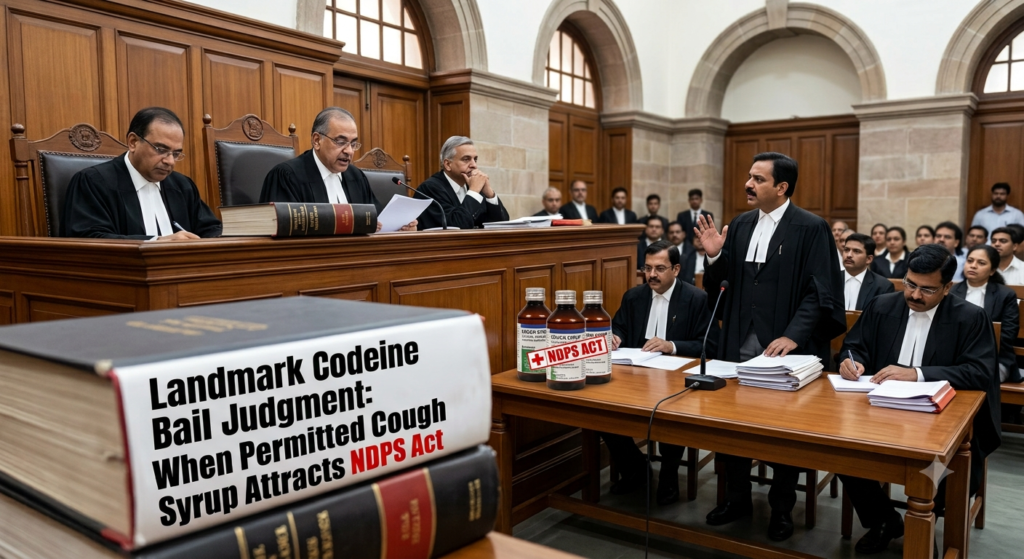
On September 1, 2026, the Allahabad High Court delivered a watershed judgment on a critical question: does a codeine-based cough syrup containing the permitted quantity of codeine fall under the Narcotic Drugs and Psychotropic Substances (NDPS) Act when sold, stocked, or transported in violation of its license conditions?
This landmark ruling consolidated 76 bail applications and provides clarity on one of the most contested issues in pharmaceutical criminal law. While the drugs contain therapeutic levels of codeine, the judgment established that how they are distributed matters as much as what they contain. For lawyers, law students, and pharmaceutical businesses, this precedent is essential reading.
Case Overview
| Parameter | Details |
|---|---|
| Court | High Court of Judicature at Allahabad |
| Judgment Date | September 1, 2026 (Reserved: August 25, 2026) |
| Bench | Hon’ble Arun Kumar Singh Deshwal, J. |
| Case Number | Criminal Misc. Bail Application No. 418 of 2026 (+ 75 consolidated applications) |
| Reported In | Allahabad High Court (2026) |
| Subject Matter | NDPS Act applicability to permitted-quantity codeine cough syrups |
| Common Issue | Stock, sale, and transport of codeine-based cough syrups (Phensedyl, Eskuf, Codectus, Lykarex-T, Phencypink-T, Rexley-T) |
Background and Facts
Between January 2024 and August 2026, police across Uttar Pradesh arrested 76 individuals—including stockists, dealers, retailers, distributors, and common transporters—under NDPS Act provisions. The common allegation: unauthorized possession, sale, stocking, and transportation of codeine-based cough syrups.
The key factual patterns:
Pattern 1: Large-scale diversion – Proprietors of medical shops purchased thousands of bottles (ranging from 20,000 to 91,000 bottles) of codeine cough syrup within short periods but could not produce sales records. For example:
- Usman Khan: purchased 42,000 bottles; produced records for only 2,000
- Salman Khan: purchased 91,000 bottles; produced records for only 2,000
- Harsh Agarwal: purchased 79,087 bottles; produced records for only 36,700 bottles
Pattern 2: Unofficial transportation – Individuals transported 100–200 bottles of cough syrup on motorcycles or in vehicles without proper documentation, licenses, or public witnesses to the recovery.
Pattern 3: Documentary red flags – Forged invoices, no e-way bills, absence of toll plaza records confirming actual transportation, transfers of large sums (₹2-4 crores) in cash without corresponding business records.
Pattern 4: Third-party involvement – Individuals like Azad Singh were arrested solely on the basis of accompanying co-accused to shop locations, with minimal incriminating material.
The Central Legal Issue
The Question Before the Court:
Whether codeine-based cough syrup having the permitted quantity of codeine (i.e., within therapeutic limits) and established in therapeutic practice will attract the provisions of the NDPS Act, if the same is sold, transported, or stocked in violation of the conditions of the license issued under the Drugs and Cosmetics Act.
Arguments of the Applicants (Accused Persons)
Senior Advocates G.S. Chaturvedi, Nipun Singh, and Sushil Shukla argued on behalf of all applicants. Their core submissions:
1. The Permitted Quantity Argument
Codeine is a narcotic drug under the NDPS Act, but codeine-based cough syrup is not a narcotic drug because:
- Entry 35 of the Notification dated November 14, 1985 (issued under Section 2(xi)(b) of NDPS Act) declares several narcotic substances and their preparations as manufactured drugs subject to a condition that codeine should not exceed 100 mg per dose unit and concentration should not exceed 2.5% in undivided preparations.
- The syrups in these cases contain only 0.2% codeine—far below the 2.5% threshold.
- Therefore, they fall outside the definition of “manufactured drugs” and NDPS Act provisions do not apply.
2. The License Compliance Argument
- Codeine-based cough syrups are regulated under the Drugs and Cosmetics Act, not the NDPS Act.
- The Drugs and Cosmetics Rules, 1985, Schedule H and H(1), govern their sale.
- Violation of license conditions under the Drugs Act is punishable under that Act, not under NDPS.
3. Labeling Standards Argument
- The Rules require drugs with narcotic content to be labeled “NRx” (narcotic prescription).
- These syrups are labeled “Rx” (normal prescription), indicating they are non-narcotic.
4. The Therapeutic Practice Doctrine
- Relying on Vibhor Rana v. Union of India (2021 SCC OnLine All 908), counsel argued that “therapeutic practice” in Entry 35 cannot be altered to mean “therapeutic purposes.”
- Mere use or misuse by end users does not change the governing law.
5. Central Drug Authority Clarification (2009)
- A notification dated May 2, 2009, by the Central Drug Authority clarified that phensedyl is regulated by the Drugs Act, not the NDPS Act.
- This administrative clarification should control interpretation.
6. Precedents Favoring Applicants
- Ashok Kumar v. Union of India (2014 SCC OnLine All 16411): Phensedyl with less than 100 ml codeine per dosage unit is not a narcotic drug.
- Mohd. Sahabuddin v. State of Assam (2012) 13 SCC 491: Distinguished because that case involved codeine exceeding permitted limits.
- Sanjeev v. State of Bihar (Criminal Misc. No. 20517 of 2026, Patna High Court): Phensedyl within permissible limits is not a narcotic drug.
Arguments of the State (Opposite Party)
Additional Advocate General Anoop Trivedi and State counsel opposed the bail applications with these submissions:
1. The Twin Conditions Doctrine
- The Notification of November 14, 1985, imposes two mandatory conditions for exclusion:
- (1) Codeine concentration should not exceed 2.5% in the preparation, and
- (2) The preparation must be “established in therapeutic practice.”
- Both conditions must be satisfied simultaneously.
2. The “Therapeutic Practice” Misinterpretation Argument
- The applicants incorrectly distinguish “therapeutic practice” from “therapeutic purposes.”
- If a preparation is diverted for purposes other than therapeutic use, it loses the protection of Entry 35.
- Large-scale diversion (tens of thousands of bottles within months) proves non-therapeutic use.
3. Codeine as an Opium Derivative
- Codeine is specifically mentioned in Section 2(xvi) of NDPS Act as an opium derivative.
- Opium derivatives are defined as manufactured drugs under Section 2(xi).
- Therefore, codeine in any form (including as syrup) is a manufactured drug under NDPS.
4. The Diversion Pattern Argument
- Evidence showed that applicants could not account for bulk purchases—a clear indication of diversion for non-medicinal purposes.
- Toll plaza records, transporter statements, and lack of sales documentation proved illegal trafficking.
- The cases do not involve regulatory violations alone; they involve illegal diversion.
5. The Drug Authority Notification Challenge
- The May 2, 2009 notification is merely an administrative instruction, not a judicial interpretation of the law.
- Courts alone have the exclusive domain to interpret statutes.
- Administrative clarifications cannot override legislative intent.
6. Reliance on Mohd. Sahabuddin
- That Supreme Court judgment is good law and applies even when recovered codeine syrup contains permitted quantities.
- The case prescribed satisfaction of twin conditions for exception.
Court’s Analysis and Reasoning
The Court embarked on a meticulous examination of statutory language, precedent, and legislative intent.
1. The Central Question Formulated
The Court reformulated the legal question as: Does the mere fact that codeine-based cough syrup contains permitted quantities make it fall outside NDPS Act, or must we examine the actual use and distribution pattern to determine applicability?
2. Interpretation of Entry 35 of the 1985 Notification
The Court analyzed the exact wording of Entry 35:
“Preparations containing codeine not more than 100 mg of drug per dose, subject to the condition that the concentration of codeine should not exceed 2.5% in undivided preparations, provided that such preparations have been established in therapeutic practice.”
Key Finding: The phrase “established in therapeutic practice” is not merely descriptive; it is a condition precedent. Both the quantity threshold AND the therapeutic practice condition must be satisfied.
The Court rejected the applicants’ argument that “therapeutic practice” is static and unrelated to actual use.
3. The Opium Derivative Doctrine
The Court upheld that codeine, as an opium derivative under Section 2(xvi) of NDPS Act, falls within the definition of manufactured drugs under Section 2(xi). However, Entry 35 creates a qualified exception for preparations:
- (a) Of specified concentration, and
- (b) Used in therapeutic practice.
Entry 35 thus operates as a carve-out from the general rule that opium derivatives are manufactured drugs.
4. The Therapeutic Practice Test – A Dynamic Standard
Critical Principle Established:
The therapeutic practice condition is not static. A cough syrup that begins in therapeutic practice can lose that status through diversion for non-therapeutic purposes. The Court held:
“The expression ‘therapeutic practice’ in Entry 35 must be understood as requiring that the preparation be intended for and used in accordance with therapeutic principles. Diversion en masse for purposes other than medicinal use is inconsistent with ‘therapeutic practice.'”
5. The Diversion Test
The Court developed a practical test to identify illegal diversion:
Indicators of Non-Therapeutic Use:
- Bulk purchases (thousands of bottles) without corresponding sales records
- Absence of proper documentation (e-way bills, transporter records, toll plaza confirmations)
- Large-scale cash transfers without business rationale
- Forged invoices or false sales records
- Timeline inconsistencies (e.g., 42,000 bottles purchased in 7 months with no documented sale)
- Sale to shell companies or non-existent businesses
- Recovery without public witnesses or proper procedures
6. The Quantity vs. Pattern Analysis
The Court rejected a purely quantitative interpretation of the law. It held that the pattern of distribution is equally important as the quantity contained in individual bottles. A legally permitted drug distributed illegally becomes contraband.
7. Drugs and Cosmetics Act Not a Bar to NDPS Act
The Court clarified that the applicants’ argument—that regulation under the Drugs Act precludes NDPS Act applicability—is untenable. A single substance can be subject to regulation under multiple statutes. Violation of Drugs Act conditions does not immunize an accused from NDPS Act prosecution if the substance is diverted for non-therapeutic use.
8. The Drug Authority Notification (2009)
The Court treated the May 2, 2009 notification with skepticism, noting that administrative clarifications cannot supersede statutory interpretation or override legislative intent. However, the Court noted that the notification itself contemplates regulation under the Drugs Act, not immunity from NDPS Act.
9. Precedent Analysis
Vibhor Rana (2021 SCC OnLine All 908): The Court distinguished this Division Bench judgment, noting that Vibhor Rana examined permissibility in isolation. It did not address large-scale diversion or non-therapeutic trafficking. The present judgment extends the law beyond Vibhor Rana.
Ashok Kumar (2014 SCC OnLine All 16411): Distinguished on facts; that case did not involve evidence of diversion.
Mohd. Sahabuddin (2012 SCC 491): The Court noted that while Sahabuddin involved exceeded quantities, its ratio regarding the twin conditions remains valid: Entry 35 protects only preparations that satisfy both the quantitative and therapeutic practice conditions.
Ratio Decidendi
The Core Legal Principle:
Codeine-based cough syrups containing permitted quantities (not exceeding 2.5% codeine) are exempt from NDPS Act classification only when they are:
- Quantitatively within limits (≤2.5% concentration, ≤100 mg per dose), AND
- Therapeutically intended and used (distributed through lawful channels, documented, to licensed retailers for prescriptive sale).
When codeine-based cough syrups are diverted for purposes other than therapeutic use—evidenced by bulk purchases without sales records, lack of documentation, cash transfers, forged invoices, or sales to unauthorized persons—they attract the provisions of the NDPS Act regardless of their permitted quantitative composition.
Secondary Principles:
- The therapeutic practice condition is dynamic, not static; it relates to actual use and distribution, not merely formulation.
- Regulatory violations under the Drugs and Cosmetics Act do not insulate an accused from NDPS Act prosecution.
- Both quantitative compliance AND therapeutic use must be proven for the Entry 35 exception to apply.
- Courts, not administrative authorities, have the exclusive power to interpret statutory provisions.
Final Orders and Relief Granted
The judgment resulted in mixed outcomes across the 76 applications:
Applications Allowed (Bail Granted): ~50 applicants
Examples of Bail Grants:
- Vikesh @ Pappu: Granted bail despite alleged possession of 16 cartons of codeine syrup. Reason: Only co-accused confessional statement; no corroborating material; chargesheet filed; consideration of overcrowded jails and Kapil Wadhawan v. CBI (2025 SCC OnLine SC 3038) guidelines.
- Priyanka Gupta: Granted bail as an incidental accused (wife of proprietor) with no criminal history; being a woman entitled her to bail under Section 480(1) BNSS.
- Zeeshan: Granted bail; only 100 bottles recovered; small quantity; no public witness; no evidence of trafficking.
- Pankaj Kumar: Granted bail; no delivery evidence; detailed affidavit explaining financial transfers; chargesheet filed.
- Mohd. Aslam: Granted bail; only co-accused statement against him; no independent material.
- Ankush Singh: Granted bail; involvement based only on co-accused’s confessional statement; deposit of ₹4,50,000 insufficient for trafficking charge.
- Azad Singh @ Golu: Granted bail; merely accompanied co-accused to shop; no material against him.
Applications Rejected (Bail Denied): ~26 applicants
Examples of Bail Rejections:
- Usman Khan: Rejected. Purchased 42,000 bottles; sales records for only 2,000; inability to account for 40,000 bottles over 7 months; forged invoices; clear diversion pattern.
- Salman Khan: Rejected. Purchased 91,000 bottles; sales records for only 2,000; 5,353 bottles per month (abnormal); forged invoices.
- Harsh Agarwal: Rejected. Purchased 79,087 bottles; sales records for only 36,700; 11,300 bottles per month (abnormal); forged invoices; prima facie trafficking evidence.
- Ravikar Singh: Rejected. Purchased 1,18,000 bottles; no actual delivery per toll plaza records; sales to non-existent firms; ₹2 crore transfers without business basis.
- Faijur Rahman: Rejected. Proprietor of J.K. Pharma with no business but ₹4.30 crores deposited in cash; handler of trafficking operation; massive cash transfers without legitimate business purpose.
Conditional Bail Grants
All applicants granted bail were required to furnish:
- Personal bond
- Two sureties each in a like amount
- Compliance with additional conditions (typically including non-contact with co-accused, regular police reporting, etc.)
Important Legal Provisions
1. Narcotic Drugs and Psychotropic Substances Act, 1985 – Section 2(xi)
Definition of Manufactured Drug:
“‘Manufactured drug’ means—
(a) all products and preparations other than those in their natural state of plants which are listed in Schedule I or Schedule II and which contain any narcotic drug or psychotropic substance…”
Application: Codeine syrups, as preparations containing codeine (an opium derivative), fall within this definition unless exempted by a notification.
2. Notification dated November 14, 1985 – Entry 35
“Preparations containing codeine not more than 100 mg per dose, subject to the condition that concentration of codeine should not exceed 2.5% in undivided preparations, provided that such preparations have been established in therapeutic practice…”
Application: This entry creates a qualified exception. The Court interpreted it to require both quantitative compliance AND therapeutic practice.
3. NDPS Act – Section 2(xvi)
Definition of Opium Derivatives:
“‘Opium derivatives’ means all manufactured drugs containing alkaloid of opium…”
Application: Codeine, being an alkaloid derived from opium, is specifically an opium derivative and thus a manufactured drug.
4. Drugs and Cosmetics Act, 1940 – Schedule H and H(1)
Codeine-based cough syrups are listed in Schedule H and H(1), requiring:
- Sale only on prescription
- Record maintenance under Rule 65(5)
- Proper labeling (Rx vs. NRx) under Rule 97©
Application: Unauthorized sale, stocking, or transportation in violation of these rules may constitute an offense under the Drugs and Cosmetics Act. However, large-scale diversion also attracts NDPS Act prosecution.
5. Bharatiya Nyaya Sanhita (BNS), 2023 – Sections Invoked
- Section 318(4): Wrongful restraint
- Section 336(3): Act endangering life or personal safety
- Section 338: Causing hurt
- Section 340(2): Criminal wrongful restraint
- Section 480(1): Special provision for bail to women (cited in Priyanka Gupta case)
6. Bail Jurisprudence – Kapil Wadhawan v. CBI (2025 SCC OnLine SC 3038)
The Court repeatedly cited this Apex Court judgment, which mandates consideration of:
- Overcrowded jails
- Heavy pendency of criminal cases
- Nature of the offense
- Evidence and complicity
- Possibility of flight risk
Application: Even where prima facie material exists, discretionary bail may be granted if custodial interrogation is not required (e.g., chargesheet filed) and excessive incarceration appears unjust.
Ratio Decidendi (Expanded)
The judgment establishes the following binding principles:
Principle 1: The Two-Pronged Test for Entry 35 Exception
Codeine-based preparations are exempt from NDPS Act classification only if they satisfy:
- Quantitative Condition: Codeine concentration ≤ 2.5%; codeine per dose ≤ 100 mg.
- Therapeutic Practice Condition: The preparation must be used in accordance with established therapeutic principles, not diverted for non-therapeutic purposes.
Failure on either prong results in NDPS Act applicability.
Principle 2: Therapeutic Practice is Evidential, Not Presumptive
The phrase “established in therapeutic practice” creates an affirmative condition, not a blanket exemption based on formula alone. Evidence of:
- Disproportionate purchases
- Absent sales records
- Unauthorized distribution
- Use by non-licensed retailers
…demonstrates deviation from therapeutic practice and reactivates NDPS Act applicability.
Principle 3: The Opium Derivative Status is Inalienable
Codeine remains an opium derivative and thus a manufactured drug under Section 2(xi). Entry 35 provides a qualified exception only, not a reclassification. If the conditions of Entry 35 are not met, NDPS Act applies ipso facto.
Principle 4: Administrative Clarity vs. Judicial Interpretation
While administrative clarifications (such as the 2009 Drug Authority notification) may provide guidance, they do not bind courts in statutory interpretation. Judicial interpretation of the NDPS Act is the authoritative source of law.
Principle 5: Concurrent Applicability of Multiple Statutes
A substance can simultaneously violate:
- The Drugs and Cosmetics Act (for license violations), and
- The NDPS Act (if diversion is proven).
These are not mutually exclusive; a person can face prosecution under both Acts for the same conduct.
Principle 6: The Practical Diversion Test
The Court provided practical indicators for identifying illegal trafficking:
- Temporal Pattern: Bulk purchases within concentrated timeframes
- Documentary Pattern: Absence of e-way bills, GST records, toll plaza confirmations
- Financial Pattern: Large cash transfers or transfers to shell entities
- Administrative Pattern: Forged invoices, falsified records, relabeling
- Evidentiary Pattern: Recovery without public witnesses or procedural compliance
Confluence of these factors shifts the burden toward proving NDPS Act violation.
Frequently Asked Questions (FAQs)
1. What is the Codeine Bail Judgment?
The Codeine Bail Judgment refers to the consolidated order dated September 1, 2026, delivered by the Allahabad High Court under Justice Arun Kumar Singh Deshwal in Criminal Misc. Bail Application No. 418 of 2026 and 75 related applications. It authoritatively interprets whether codeine-based cough syrups with permitted quantities fall under the NDPS Act.
2. Why did the Court consolidate 76 bail applications?
All 76 cases involved the same core legal issue: the applicability of NDPS Act provisions to codeine-based cough syrups. By consolidating them, the Allahabad High Court ensured consistency in judgment and provided comprehensive guidance on a recurring problem. This is a standard judicial practice when multiple cases raise identical legal questions.
3. Can I legally sell Phensedyl or other codeine cough syrups?
Yes, if you hold a valid license under the Drugs and Cosmetics Act and comply with all conditions:
- You must maintain proper records of sales.
- You must only sell to licensed retailers (not individuals).
- Each sale must be documented (prescription copy, retailer license).
- You must file e-way bills for transportation.
- Your sales volumes must align with normal pharmacy demand.
If you cannot document your sales or the volumes are disproportionate to market demand, you risk NDPS Act prosecution.
4. What does “established in therapeutic practice” mean?
It means the codeine-based preparation is used by licensed retailers and pharmacies to dispense to patients based on medical prescriptions, not for other purposes. The Court treated “therapeutic practice” as an active condition, not merely a historical classification. If you divert large quantities without documentation, you violate this condition.
5. Why did the State argue that these syrups fall under NDPS Act despite permitted quantities?
The State relied on Section 2(xi) of the NDPS Act, which defines “manufactured drugs” to include all preparations containing narcotic drugs or psychotropic substances. Codeine, being an opium derivative, falls within this definition. The State argued that Entry 35 of the 1985 Notification provides only a qualified exception requiring both quantitative compliance and therapeutic use.
6. What is the difference between “therapeutic practice” and “therapeutic purposes”?
According to the applicants (and Vibhor Rana), “therapeutic practice” is a static term referring to established medical use of the formula, while “therapeutic purposes” refers to actual end-user consumption. The Court rejected this distinction, holding that “therapeutic practice” encompasses both the formulation AND the actual distribution chain. If you divert it, therapeutic practice is violated.
7. Can I be prosecuted under both the Drugs and Cosmetics Act AND the NDPS Act for the same conduct?
Yes. The Court clarified that these are not mutually exclusive regimes. You might violate the Drugs Act by selling without proper documentation and simultaneously violate the NDPS Act if the diversion is proven. Dual prosecution is permissible and common.
8. What is the role of the 2009 Drug Authority Notification?
The Drug Authority issued a May 2, 2009 notification stating that phensedyl is regulated by the Drugs Act, not the NDPS Act. The applicants cited this as controlling law. The Court acknowledged it but rejected its binding force, noting that courts alone have authority to interpret statutes. Administrative notifications cannot override judicial interpretation.
9. How did the Court distinguish Vibhor Rana?
Vibhor Rana (2021 SCC OnLine All 908) examined the permitted quantity of codeine in isolation and concluded that permitted syrups fall outside NDPS Act. The present judgment distinguished it by holding that Vibhor Rana did not address scenarios involving large-scale diversion and absence of sales records. The present judgment extends the law to require examination of how the syrup is distributed, not merely what it contains.
10. What factors did the Court consider before granting or denying bail?
The Court applied a multi-factor test:
- Chargesheet Status: Bail is more likely if chargesheet is filed (interrogation complete).
- Evidence Category: Bail is more likely if incriminating material is limited to co-accused statements without independent corroboration.
- Diversion Indicators: Bail is denied if toll plaza records, forged invoices, and bulk purchases without sales records prove trafficking.
- Personal Factors: Gender, criminal history, age, family support all count.
- Overcrowded Jails Principle: Kapil Wadhawan mandates considering jail congestion and case pendency.
11. Is possession of 100 bottles of codeine syrup a crime?
It depends on context:
- If you hold a valid stockist/dealer license and have documentation of lawful purchase and sale, possession of 100 bottles is lawful.
- If you possess 100 bottles on a motorcycle without a license, without documentation, and without a legitimate business purpose, it attracts NDPS Act prosecution.
12. What should I do if I’m arrested for codeine syrup possession?
Immediately:
- Do not make statements to police without a lawyer.
- Preserve all documentation: invoices, e-way bills, prescriptions, bank records.
- Engage a criminal lawyer experienced in pharmaceutical law.
- File for bail citing the present judgment and the Kapil Wadhawan principles.
- Gather character references and evidence of lawful business (if applicable).