

Introduction
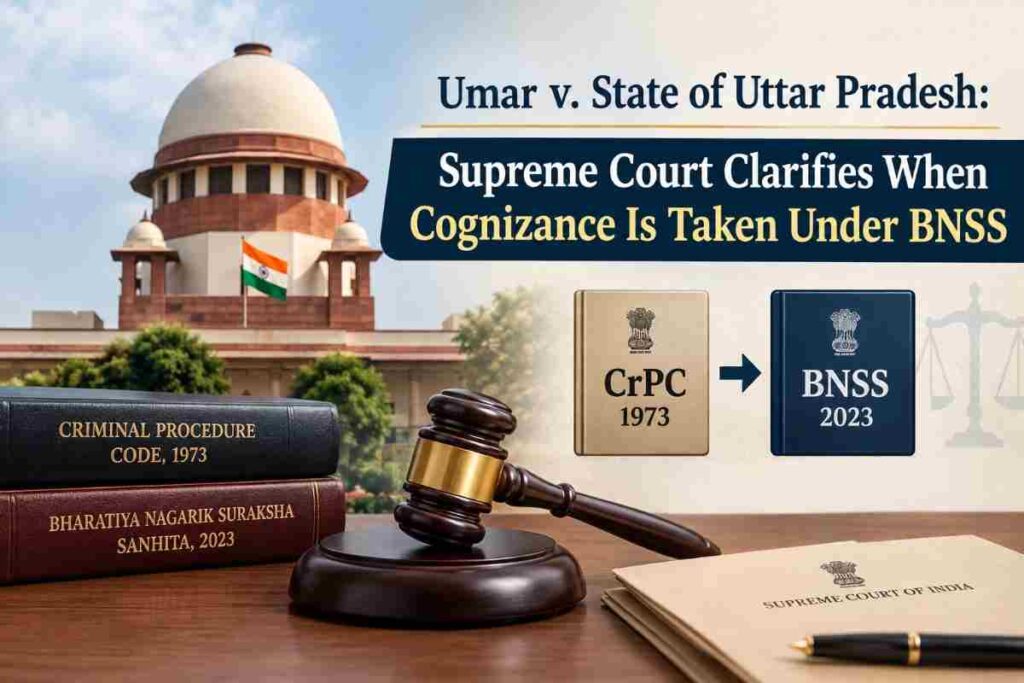
The Supreme Court of India has clarified an important procedural question concerning the transition from the Code of Criminal Procedure, 1973 (CrPC) to the Bharatiya Nagarik Suraksha Sanhita, 2023 (BNSS).
In Umar and Another v. State of Uttar Pradesh and Another, the Court considered whether cognizance of an offence had already been taken before the BNSS came into force on 1 July 2024, or whether cognizance was actually taken later, in 2026. The distinction was significant because, under the BNSS, the accused is required to be heard before cognizance is taken in the circumstances considered by the Court.
The Supreme Court held that merely taking a protest complaint on record and directing examination of the complainant does not, by itself, establish that cognizance has been taken. Cognizance involves the application of judicial mind to the offence.
In the present case, the Court found that the judicial mind was applied only on 3 June 2026, when the Special Judge found a prima facie case and ordered issuance of process. Since this was after the BNSS had come into force, the accused was required to be heard before cognizance was taken.
Case Details
| Particular | Details |
|---|---|
| Case Name | Umar and Another v. State of Uttar Pradesh and Another |
| Court | Supreme Court of India |
| Case Number | Criminal Appeal arising out of SLP (Crl.) No. 14343 of 2026 |
| Judgment/Order Date | 23 September 2026 |
| Bench | Justice J.B. Pardiwala and Justice K. Vinod Chandran |
| Relevant Law | Code of Criminal Procedure, 1973 and Bharatiya Nagarik Suraksha Sanhita, 2023 |
| Principal Issue | Whether cognizance had been taken before or after the BNSS came into force |
The judgment is recorded as 2026 INSC 1058.
Background and Facts of the Case
An FIR was registered on 7 June 2022. Following investigation, the police submitted a Closure Report on 6 August 2022.
A protest petition was filed on 14 October 2022, following which the Court directed further investigation under Section 173(8) of the CrPC on 29 November 2022.
After further investigation, another Closure Report was filed on 14 February 2023. The complainant again filed a protest petition on 28 April 2023.
The complaint was taken on board on 11 October 2023 and was posted for recording the complainant’s statement. The complainant and other witnesses were eventually examined on 6 March 2024. The complainant was examined as PW1, her husband as PW2 and a doctor as PW3.
However, no order deciding the matter was passed at that stage and the proceedings remained pending.
The position changed on 3 June 2026, when the Special Judge, SC/ST, Azamgarh, passed a detailed order finding prima facie commission of the alleged offences and issuing process against the respondents.
The dispute before the Supreme Court therefore centred on the precise point at which cognizance had been taken.
Legal Issue Before the Supreme Court
Whether cognizance had been taken before or after the BNSS came into force?
The principal question before the Supreme Court was whether the Court had already taken cognizance when the protest petition was placed before it and the complainant’s evidence was directed to be recorded, or whether cognizance was taken only when the Court applied its judicial mind on 3 June 2026.
This question had a direct procedural consequence because the BNSS came into force on 1 July 2024.
Arguments of the Parties
Arguments of the Appellants
The appellants argued that the order dated 3 June 2026 was the order by which cognizance was actually taken.
Since the BNSS was already in force by that date, they contended that the procedure under the BNSS was applicable. They particularly relied upon the proviso to Section 223 of the BNSS, which requires the accused to be given an opportunity of being heard before cognizance is taken in the relevant circumstances.
Reliance was also placed on the Supreme Court’s decision in Parvinder Singh v. Directorate of Enforcement, where the Court considered cognizance as an application of judicial mind and discussed the procedural consequences under the BNSS.
Arguments of the State
The State disputed the appellants’ contention and argued that cognizance had already been taken before the BNSS came into force.
Therefore, according to the State, the later proceedings did not amount to taking cognizance for the first time after the introduction of the BNSS.
Arguments of the Complainant
The complainant argued that cognizance had already been taken when the complaint was accepted and proceedings commenced.
Reliance was placed on CREF Finance Ltd. v. Shree Shanthi Homes (P) Ltd. and Zunaid v. State of Uttar Pradesh, to contend that cognizance should not be confused with issuance of process and that a formal order using the expression “cognizance taken” is not necessarily required.
Court’s Analysis and Reasoning
Cognizance is different from issuance of process
The Supreme Court first considered the meaning of cognizance under criminal procedure.
In CREF Finance Ltd. v. Shree Shanthi Homes (P) Ltd., the Court had explained that cognizance is taken of the offence, not of the offender. Therefore, the act of issuing process against an accused should not automatically be treated as identical to the act of taking cognizance.
The Court also noted that cognizance is used in the CrPC to describe the stage at which the Magistrate or Judge takes judicial notice of an offence. The expression does not have one rigid meaning applicable to every procedural situation.
What did Zunaid establish?
The Court also referred to Zunaid v. State of Uttar Pradesh & Ors.
The judgment explained that when a police report is submitted under Section 173 of the CrPC, whether it is a Closure Report or a chargesheet, the Magistrate has different options.
These include dropping the proceedings, taking cognizance and issuing process despite the police conclusion, or taking cognizance on the basis of the original complaint and proceeding to examine the complainant and witnesses under Section 200 CrPC.
This distinction was important because the Court had to examine what the Special Judge had actually done at each stage of the present proceedings.
Application of judicial mind is central to cognizance
The Supreme Court then considered Parvinder Singh v. Directorate of Enforcement.
The Court noted that taking cognizance essentially involves the application of judicial mind. Until the judicial mind is applied to the material for determining whether the offence should be proceeded with, the inquiry cannot be said to have commenced in the relevant sense.
The Court further noted that while this concept existed under the CrPC, the BNSS introduced an additional requirement concerning hearing the accused before cognizance in the situation contemplated by the statutory provision.
Why did the Supreme Court hold that cognizance was taken in 2026?
This was the central part of the judgment.
The Supreme Court examined the actual orders passed by the Special Judge rather than merely looking at the date on which the protest petition was filed or the complaint was taken on record.
The first relevant order directed that the complainant be produced for evidence under Section 200 CrPC. According to the Supreme Court, this showed that the Court had not yet applied its judicial mind to determine whether the alleged offences had been made out.
The complainant and other witnesses were subsequently examined on 6 March 2024, but no final judicial determination was made at that stage. The matter remained pending for almost two years.
The position was materially different on 3 June 2026.
On that date, the Special Judge recorded a finding that a prima facie case existed and issued process against the accused.
According to the Supreme Court, it was this second order that demonstrated the application of judicial mind. Therefore, cognizance was deemed to have been taken through the order dated 3 June 2026.
Effect of the BNSS Coming Into Force
The BNSS came into force on 1 July 2024. In the present case, the Supreme Court found that cognizance had not been taken before that date.
Consequently, the relevant procedural requirement under the BNSS applied to the stage at which cognizance was to be taken.
The Supreme Court therefore held that the accused ought to have been summoned and heard before the Court proceeded to take cognizance on the basis of its prima facie finding.
The judgment thus demonstrates why identifying the exact procedural stage at which cognizance is taken can become particularly important in cases that straddle the transition from the CrPC to the BNSS.
Judgment and Final Decision
The Supreme Court set aside the order dated 3 June 2026 to the extent that it recorded a prima facie case and treated cognizance as having been taken.
However, the Court did not terminate the proceedings altogether.
Instead, it confined the order to a “summons simplicitor” and directed the appellant-accused to appear before the concerned Court within one month.
The matter was thereafter to be heard and appropriate orders passed, including on a day when the complainant or her counsel was present.
The appeal was allowed, but the Supreme Court expressly made no observations on the merits of the case.
Ratio Decidendi
The core principle emerging from the judgment is that cognizance is linked to the application of judicial mind to the offence.
The mere act of taking a complaint on record or directing the examination of the complainant does not necessarily mean that cognizance has been taken.
Where the Court initially proceeds under Section 200 CrPC by requiring the complainant and witnesses to give evidence, but subsequently applies its judicial mind and records a prima facie finding leading to issuance of process, the latter stage may constitute the point at which cognizance is taken.
In this case, that stage occurred on 3 June 2026, after the BNSS had come into force. The accused therefore had to be heard before cognizance was taken in accordance with the applicable BNSS procedure.
Important Legal Provisions
Section 200 CrPC
Section 200 of the Code of Criminal Procedure deals with the examination of the complainant upon oath when a Magistrate takes cognizance of a complaint.
In the present case, the Special Judge directed the complainant and witnesses to be examined. The Supreme Court treated this stage as part of the process preceding the actual application of judicial mind that resulted in cognizance being taken in 2026.
Section 173(8) CrPC
Section 173(8) concerns further investigation after a police report has been submitted.
In the present case, further investigation was ordered after the first protest petition against the Closure Report.
Section 223 BNSS
The appellants relied upon the proviso to Section 223 of the BNSS concerning the opportunity of hearing to the accused before cognizance.
The Supreme Court applied this procedural requirement after determining that cognizance had actually been taken after the BNSS came into force.
Important Precedents
| Case | Principle | Use in the Present Case |
|---|---|---|
| CREF Finance Ltd. v. Shree Shanthi Homes (P) Ltd. | Cognizance is taken of the offence and should not be confused with issuance of process against the offender. | Used to explain the nature and stage of cognizance. |
| Zunaid v. State of Uttar Pradesh & Ors. | A Magistrate has different options after receiving a police report, including proceeding on the original complaint. | Used to explain the procedural choices following a Closure Report. |
| Parvinder Singh v. Directorate of Enforcement | Cognizance involves application of judicial mind; the BNSS introduces the relevant hearing requirement before cognizance. | Used to determine when judicial mind was actually applied in the present case. |
These are the precedents expressly discussed in the judgment.
What This Judgment Means
For accused persons
The judgment highlights the importance of identifying the exact stage at which a criminal court applies its judicial mind and takes cognizance.
Where cognizance occurs after the BNSS came into force, the procedural safeguards applicable under the BNSS become relevant.
For lawyers
For practitioners, the judgment reinforces the need to examine the wording and substance of orders passed at different stages rather than assuming that cognizance was taken merely because a complaint was accepted or evidence was recorded.
The distinction between taking a complaint on record, conducting proceedings under Section 200 CrPC, applying judicial mind, taking cognizance and issuing process can be legally significant.
For law students and judiciary aspirants
The case provides a useful illustration of the difference between:
- taking cognizance of an offence;
- recording the complainant’s evidence;
- applying judicial mind;
- finding a prima facie case; and
- issuing process against the accused.
It also demonstrates how procedural changes introduced by the BNSS can affect cases that began under the CrPC but continued after 1 July 2024.
Key Takeaways
- Cognizance is fundamentally connected with the application of judicial mind.
- Taking a complaint on record does not automatically establish that cognizance has been taken.
- Recording evidence under Section 200 CrPC does not, by itself, determine the point of cognizance.
- The Court must examine the substance of the orders passed during the proceedings.
- In this case, the Supreme Court identified 3 June 2026 as the stage when judicial mind was applied and cognizance was taken.
- The BNSS had already come into force by that date.
- The accused therefore had to be heard before cognizance was taken as required by the applicable BNSS procedure.
- The Supreme Court set aside the order to the extent that it recorded a prima facie case and cognizance.
- The proceedings were not terminated on merits.
- The matter was directed to proceed after the accused appeared and the parties were heard.
Frequently Asked Questions
What did the Supreme Court hold in Umar v. State of Uttar Pradesh?
The Supreme Court held that cognizance was taken only when the Court applied its judicial mind and found a prima facie case on 3 June 2026. Since this was after the BNSS came into force, the accused was required to be heard before cognizance was taken.
What was the main issue in Umar v. State of Uttar Pradesh?
The main issue was whether cognizance had already been taken before 1 July 2024, when the BNSS came into force, or whether cognizance was taken through the order dated 3 June 2026.
Does taking a complaint on record amount to taking cognizance?
Not necessarily. The Supreme Court examined the substance of the proceedings and held that taking the complaint on record and directing the complainant’s examination did not, in the circumstances of this case, amount to taking cognizance.
What is the importance of judicial mind in taking cognizance?
The judgment explains that cognizance involves the Court applying its judicial mind to the offence. In this case, the relevant application of judicial mind occurred when the Court found a prima facie case and proceeded to issue process.
What happened on 3 June 2026?
The Special Judge found prima facie commission of the alleged offences and issued process against the accused. The Supreme Court treated this order as the point at which cognizance was taken.
Why was the BNSS relevant in this case?
The BNSS came into force on 1 July 2024. Since the Supreme Court found that cognizance was taken in June 2026, the procedural requirements of the BNSS applied at that stage.
What did the Supreme Court do with the 3 June 2026 order?
The Court set aside the order to the extent that it recorded a prima facie case and treated cognizance as having been taken. It confined the order to a summons simplicitor and directed the accused to appear before the Court.
Did the Supreme Court decide whether the accused were guilty?
No. The Supreme Court expressly stated that the appeal was allowed without making any observations on the merits of the matter.
Conclusion
The decision in Umar and Another v. State of Uttar Pradesh and Another provides an important clarification on identifying the point at which cognizance is actually taken, particularly in proceedings that continued across the transition from the CrPC to the BNSS.
The Supreme Court looked beyond the mere filing and acceptance of the complaint and examined the actual judicial orders passed during the proceedings. It concluded that the decisive stage was the order dated 3 June 2026, when the Court found a prima facie case and applied its judicial mind.
Because this occurred after the BNSS came into force, the accused was entitled to the procedural safeguard of being heard before cognizance was taken. The Court therefore corrected the procedural stage without making any determination on the merits of the allegations.
For practitioners and students, the judgment is particularly useful for understanding that cognizance is a matter of judicial application of mind, not merely a formal consequence of a complaint being placed before the Court.