

Introduction
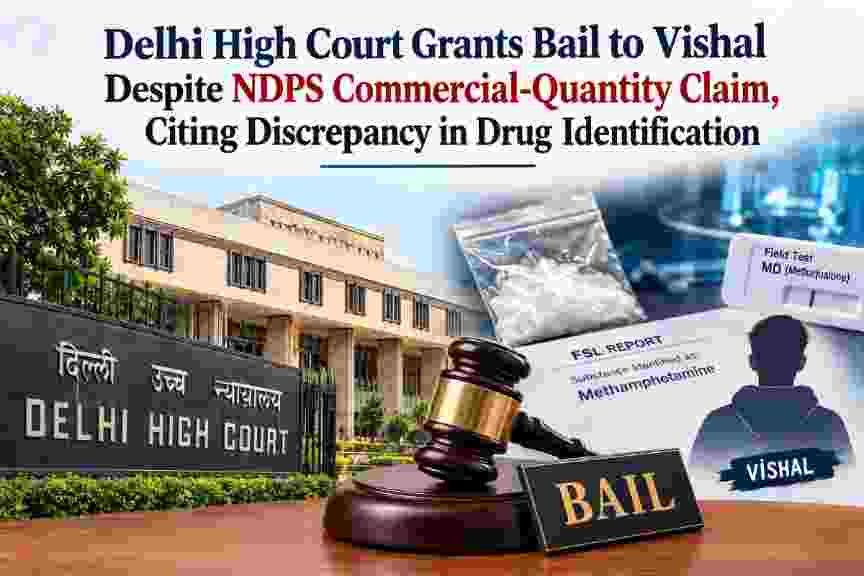
The Delhi High Court has granted regular bail to Vishal, an accused in an NDPS case arising out of FIR No. 0085/2026 registered at Police Station New Friends Colony, South-East Delhi. The case involved a recovery of 99.25 grams of contraband from co-accused Kartik. While the field-testing kit initially indicated the substance as MD (Methaqualone), the subsequent FSL report identified it as Methamphetamine.
The discrepancy was significant because the quantity thresholds for commercial quantity differ substantially for the two substances. The Delhi High Court held that this discrepancy had a crucial bearing on the application of the stringent conditions under Section 37 of the NDPS Act.
The Court also took note of the fact that no contraband was recovered from Vishal, either from his person or from his scooter, and that the prosecution’s allegation regarding his involvement substantially rested upon the disclosure statement of the co-accused.
Case Details
| Particular | Details |
|---|---|
| Case | Vishal v. State NCT of Delhi |
| Court | High Court of Delhi at New Delhi |
| Case Number | BAIL APPLN. 3111/2026 |
| Date of Decision | 6 October 2026 |
| Bench | Justice Sachin Datta |
| FIR | FIR No. 0085/2026 |
| Police Station | New Friends Colony, South-East Delhi |
| Statutes | NDPS Act, 1985; BNSS, 2023 |
| Key Provision | Section 37 of the NDPS Act |
| Relief | Regular bail |
The order was passed by Justice Sachin Datta on 6 October 2026.
Background and Facts of the Case
The prosecution alleged that on 26 March 2026, the Anti-Narcotics Squad received secret information that Kartik, allegedly with the assistance of Vishal, was supplying MD (Methaqualone). A raid was consequently conducted near SPA Gate No. 1, Gurudwara Road, Taimoor Nagar, New Friends Colony, Delhi.
At approximately 11:10 PM, Kartik arrived in a car while Vishal arrived on a TVS scooter. Both were apprehended. A packet weighing 99.25 grams, including the polythene, was recovered from Kartik’s right pocket.
The field-testing kit reportedly indicated the substance to be MD (Methaqualone). However, when the substance was subsequently examined by the Forensic Science Laboratory, it was reported to be Methamphetamine. Importantly, nothing was recovered either from Vishal personally or from his scooter.
Vishal had been arrested on 26 March 2026 and had remained in custody for several months. The charge sheet had already been filed and the case had reached the stage of arguments on charge. He was approximately 20 years old and had no previous criminal involvement according to the Delhi Prison Record.
Legal Issues Before the Court
The principal issues before the Delhi High Court were:
- Whether the stringent conditions under Section 37 of the NDPS Act applied to the applicant’s bail request.
- Whether the discrepancy between the field-test result and the FSL report created a relevant doubt regarding the quantity and nature of the alleged contraband.
- Whether the material against Vishal, including the disclosure statement of the co-accused and the reference to CCTV footage, was sufficient to deny bail.
- Whether the Court could conclude that the requirements of Section 37 were satisfied at the stage of bail.
Arguments of the Parties
Arguments on behalf of Vishal
The defence emphasised that no contraband had been recovered from Vishal. According to the defence, his mere presence at the spot could not establish possession of the contraband recovered from Kartik.
It was also argued that the case against Vishal substantially rested on the disclosure statement of the co-accused. The defence further highlighted his young age and clean antecedents.
Arguments of the State
The State opposed the bail application by relying on Section 37 of the NDPS Act. It argued that the FSL report had identified the substance as Methamphetamine and that the quantity recovered was commercial quantity.
The prosecution also relied upon CCTV footage and the disclosure statements of co-accused Sarfaraz Alam and Kartik Singh to contend that Vishal was involved in the alleged offence.
Court’s Analysis and Reasoning
Section 37 of the NDPS Act and Commercial Quantity
Section 37 imposes stringent conditions for granting bail in cases involving commercial quantities of narcotic drugs or psychotropic substances. Where the provision applies, the Court must be satisfied that there are reasonable grounds for believing that the accused is not guilty and that the accused is unlikely to commit any offence while on bail.
The High Court noted that the Supreme Court has repeatedly held that these twin conditions cannot simply be ignored while deciding bail applications involving commercial quantity.
The Court referred to State of Punjab v. Balraj Singh @ Billa and State of Meghalaya v. Lalrintluanga Sailo, both of which emphasised the mandatory consideration of the requirements under Section 37.
Discrepancy Between Field Test and FSL Report
The most significant factor in the present case was the difference between the initial field-test result and the FSL report.
The FIR recorded that the 99.25-gram substance tested positive for MD (Methaqualone). The FSL, however, identified it as Methamphetamine.
This difference was legally significant because the commercial quantity for MD (Methaqualone), as noted by the Court, is 500 grams, whereas the commercial quantity for Methamphetamine is 50 grams.
Therefore, if the substance was treated as MD (Methaqualone), 99.25 grams would not constitute commercial quantity. If it was treated as Methamphetamine, the same quantity would constitute commercial quantity.
The Court therefore held that the discrepancy had a crucial bearing on the Section 37 threshold. At the same time, the Court expressly clarified that it was not deciding the ultimate truth of the recovery or making a finding on the merits of the prosecution case.
No Recovery from the Applicant
Another important factor was that no contraband was recovered from Vishal.
The entire quantity was allegedly recovered from Kartik’s pocket, and nothing was recovered from Vishal’s scooter. The FIR also did not attribute any specific act to Vishal beyond his arrival at the spot.
The further allegation that Vishal received the contraband from Kartik and carried it on his scooter was based on the disclosure statement of the co-accused. The Court observed that this aspect would have to be tested at trial.
Evidentiary Value of Co-Accused Disclosure
The High Court also referred to the legal position concerning disclosure statements of co-accused. It noted that a statement of a co-accused without corroborating material cannot be given undue weight for drawing guilt against the applicant at the bail stage.
The Court also noted that although the prosecution referred to CCTV footage, the status report did not clearly establish what the footage showed or whether it showed Vishal personally handling any contraband.
Satisfaction of the Section 37 Conditions
Taking all these circumstances together, the Court concluded that the threshold requirement under Section 37(1)(b)(ii) was satisfied.
The Court nevertheless made it clear that this was only a tentative inference for deciding the bail application and was not a final determination regarding the applicant’s guilt or innocence.
The second requirement under Section 37 was also found satisfied. Vishal was around 20 years old, had no previous criminal involvement, had satisfactory jail conduct and had been in custody for a considerable period. The Court found no material suggesting that he was likely to commit another offence while on bail.
Judgment and Final Decision
The Delhi High Court granted regular bail to Vishal.
He was directed to furnish a personal bond of ₹25,000 with two sureties of the same amount to the satisfaction of the Trial Court. The bail was subject to several conditions.
The important conditions included:
- He could not leave the NCT of Delhi or travel outside India without prior permission of the Trial Court.
- He had to provide his permanent and residential addresses to the Trial Court.
- Any change of address had to be communicated to the Investigating Officer.
- He had to keep his mobile number operational, with location services enabled.
- He had to appear before the Investigating Officer whenever called.
- He could not contact the complainant, victim or prosecution witnesses.
- He could not threaten, induce or influence witnesses or tamper with evidence.
- He had to appear before the Trial Court on every date of hearing.
- He could not indulge in criminal activity during the period of bail.
The Court further clarified that breach of the conditions would permit the State to seek cancellation of bail. It also requested the Trial Court to expedite the proceedings to the extent feasible.
Ratio Decidendi
The central principle emerging from the order is that, even in an NDPS case where the prosecution invokes the stringent conditions applicable to commercial quantity, the Court must examine whether the statutory threshold under Section 37 is actually attracted and whether the twin conditions for bail are satisfied.
Where there is a material discrepancy regarding the identity of the alleged contraband, and where the applicant himself is not shown to have possession of the recovered substance, those circumstances may become relevant while determining whether reasonable grounds exist for the purposes of Section 37.
The Court’s conclusion was expressly tentative and limited to the bail proceedings.
Important Legal Provisions
Section 483 of the BNSS, 2023
Vishal’s application sought regular bail under Section 483 of the Bharatiya Nagarik Suraksha Sanhita, 2023. The application arose from the NDPS prosecution registered against him.
Section 37 of the NDPS Act, 1985
Section 37 imposes special restrictions on bail in specified NDPS offences, including offences involving commercial quantities.
The provision requires the Court, where the Public Prosecutor opposes bail, to be satisfied that there are reasonable grounds for believing that the accused is not guilty and that the accused is not likely to commit an offence while on bail.
In the present case, the High Court found that these requirements were satisfied on a tentative assessment of the circumstances.
Important Precedents
| Case | Principle | How It Was Used |
|---|---|---|
| State of Punjab v. Balraj Singh @ Billa | Section 37’s twin conditions must be considered in commercial-quantity cases. | Used to emphasise the mandatory statutory threshold. |
| State of Meghalaya v. Lalrintluanga Sailo | A liberal approach ignoring Section 37 is impermissible. | Reinforced the need to record satisfaction under Section 37. |
| Narcotics Control Bureau v. Mohit Aggarwal | At the bail stage, the Court need not conclusively determine guilt; it examines reasonable grounds under Section 37. | Applied to the limited nature of the bail inquiry. |
| Union of India v. Shiv Shanker Kesari | The Court is not required to conduct a full trial while considering Section 37 bail. | Used in explaining the limited nature of the bail assessment. |
| Sahil Sharma Alias Maxx v. State Govt. of NCT of Delhi | A discrepancy between field testing and FSL results can be relevant at the bail stage. | Considered in relation to the conflicting identification of the substance. |
| Ravi Manoj Rai v. Union of India | Uncorroborated statements of a co-accused cannot by themselves be given undue weight at the bail stage. | Relevant to the prosecution’s reliance on the co-accused’s disclosure. |
The above authorities were expressly discussed in the judgment.
What This Judgment Means
The judgment demonstrates that the stringent bail regime under Section 37 of the NDPS Act does not eliminate the Court’s obligation to examine the actual material available against an accused.
The identity and quantity of the alleged contraband can be important where the application of Section 37 itself depends upon whether the recovered substance falls within the commercial-quantity category.
The decision also illustrates that where an accused has no recovery from his person or vehicle, and the prosecution’s allegation of possession or involvement depends substantially on the statement of a co-accused, the Court may consider the strength of that material while deciding bail.
However, the order does not amount to an acquittal or a final finding that Vishal was innocent. The High Court expressly stated that its observations were confined to the bail application and would not influence the trial.
Key Takeaways
- Section 37 of the NDPS Act imposes stringent conditions for bail where commercial quantity is involved.
- The Court must consider the twin conditions under Section 37 before granting bail.
- A discrepancy between a field-testing kit and an FSL report may be relevant at the bail stage.
- The quantity threshold depends upon the identity of the substance allegedly recovered.
- In this case, 99.25 grams was below the commercial quantity stated for Methaqualone but above the commercial quantity stated for Methamphetamine.
- No contraband was recovered from Vishal or his scooter.
- The prosecution’s further allegation against Vishal substantially relied upon the disclosure statement of the co-accused.
- The Court found the Section 37 threshold satisfied on a tentative assessment.
- The bail order does not amount to a finding on the merits of the prosecution case.
- Breach of bail conditions can result in the State seeking cancellation of bail.
Frequently Asked Questions
What case did the Delhi High Court decide?
The case was Vishal v. State NCT of Delhi, BAIL APPLN. 3111/2026, decided by Justice Sachin Datta on 6 October 2026.
Why was Vishal granted bail?
The Court considered, among other factors, the discrepancy between the field-test and FSL identification of the substance, the absence of recovery from Vishal, the reliance on the co-accused’s disclosure statement and his clean antecedents.
What was the discrepancy in the drug identification?
The field-testing kit identified the substance as MD (Methaqualone), whereas the FSL report identified it as Methamphetamine.
Why was the discrepancy important?
The commercial quantity threshold noted by the Court was 500 grams for MD (Methaqualone) and 50 grams for Methamphetamine. Thus, 99.25 grams would have different legal consequences depending upon which substance was accepted.
Was any contraband recovered from Vishal?
No. The Court specifically noted that the entire quantity was recovered from the pocket of co-accused Kartik and nothing was recovered from Vishal or his scooter.
Did the Court acquit Vishal?
No. The order concerned regular bail. The Court expressly clarified that its observations were only for deciding the bail application and would not affect the trial.
What bail conditions were imposed?
Vishal was required to furnish a ₹25,000 personal bond with two sureties of the same amount and comply with conditions concerning travel, address, mobile phone, cooperation with investigation, non-contact with witnesses, court appearances and abstaining from criminal activity.
What is the significance of Section 37 in NDPS bail cases?
Section 37 requires the Court to consider whether there are reasonable grounds for believing that the accused is not guilty and whether the accused is unlikely to commit an offence while on bail in cases covered by its stringent requirements.