

Introduction
Can a competitor use a rival’s trademark, identify its products and scientifically discuss their ingredients in an advertisement? Yes—but not if the overall advertisement conveys a false, misleading or deceptive message about the rival’s products.
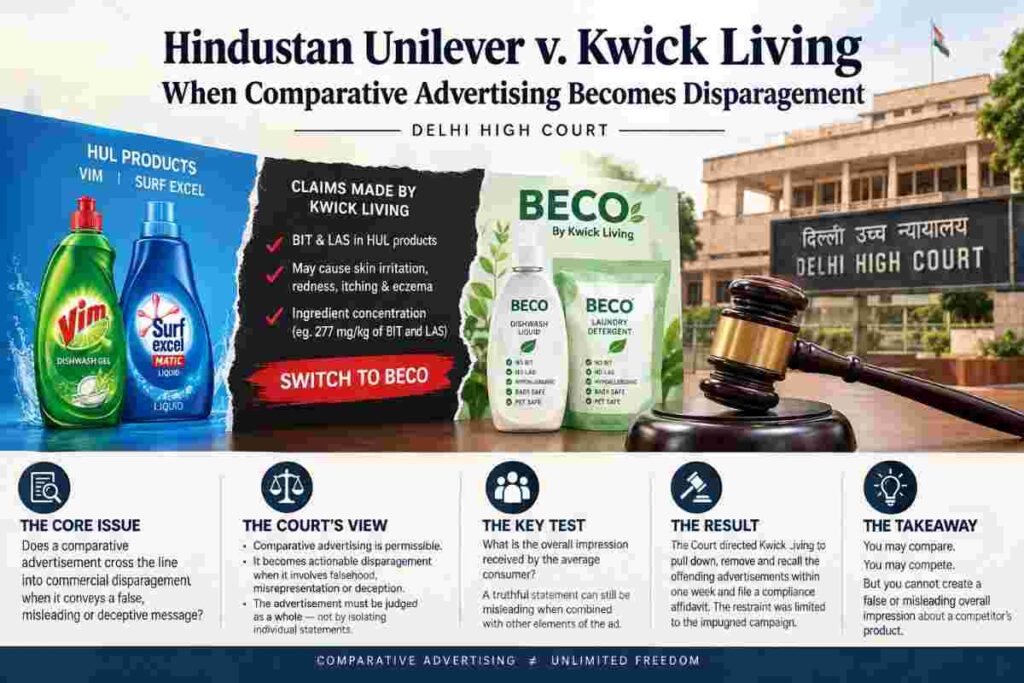
This question arose before the Delhi High Court in Hindustan Unilever Limited v. Kwick Living (I) Private Limited, concerning Kwick Living’s advertising campaign titled “War on What’s Hidden”, which targeted HUL products including VIM and SURF EXCEL. HUL alleged that the campaign falsely portrayed its products as capable of causing skin irritation and allergic reactions while promoting Kwick Living’s competing BECO products.
Justice A. J. Bhambhani, by judgment dated 10 September 2026, held at the interim stage that the campaign prima facie crossed the permissible boundaries of comparative advertising. The Court directed Kwick Living to pull down, remove and recall the offending advertisements within one week.
The judgment is particularly significant because it clarifies that truth cannot be assessed by examining isolated statements in an advertisement. The Court must consider the advertisement as a whole and ask what message an average consumer is likely to receive.
Case Details
| Particular | Details |
|---|---|
| Case Name | Hindustan Unilever Limited v. Kwick Living (I) Private Limited |
| Court | High Court of Delhi at New Delhi |
| Case Number | CS(COMM) 904/2026 |
| Application | I.A. 22515/2026 |
| Judgment Date | 10 September 2026 |
| Bench | Justice A. J. Bhambhani |
| Plaintiff | Hindustan Unilever Limited |
| Defendant | Kwick Living (I) Private Limited |
| Proceeding | Application under Order XXXIX Rules 1 & 2 read with Section 151 CPC |
| Principal Issue | Whether the impugned comparative advertising amounted to actionable commercial disparagement |
| Products involved | VIM and SURF EXCEL, among others |
| Campaign | “War on What’s Hidden” |
The plaintiff sought an interim injunction against the campaign, alleging commercial disparagement, trademark and trade-dress infringement, copyright infringement, passing off and unfair competition.
Background and Facts of the Case
The dispute arose from an advertising campaign launched by Kwick Living on 14 August 2026.
The campaign specifically referred to HUL’s products, including Surf Excel Matic Liquid and Vim Dishwash Gel. It referred to ingredients such as Linear Alkylbenzene Sulfonate (LAS) and Benzisothiazolinone (BIT) and stated that these ingredients could cause skin irritation and allergic reactions.
The campaign also highlighted specific quantities of these ingredients. For example, it stated that Surf Excel Matic Liquid contained 277 mg/kg of BIT and LAS upwards of 10%, while other advertisements referred to LAS concentrations in Surf Excel and Vim products.
The campaign then promoted Kwick Living’s competing BECO products, including advertisements asking consumers to:
“SWITCH TO BECO”
The advertisements also represented BECO products as not containing BIT or LAS and, in certain advertisements, described them as “hypoallergenic”, “baby safe” and “pet safe”.
HUL argued that the campaign went beyond legitimate consumer education and comparative advertising and created the impression that its products were unsafe.
What Was HUL’s Case?
HUL contended that Kwick Living had deliberately targeted its products by using its trademarks, packaging, products and well-known advertising expressions.
According to HUL, the campaign:
- specifically identified VIM and SURF EXCEL;
- referred to their ingredients;
- suggested that those ingredients could cause skin irritation and allergic reactions;
- portrayed HUL consumers in a negative manner;
- directed consumers towards BECO products; and
- damaged HUL’s goodwill, reputation and consumer trust.
HUL also pointed out the extensive reach of the campaign. Its application referred to individual reels having crossed 5.6 million views, YouTube advertisements having collectively crossed 1 million views, and more than 100 influencer posts using the campaign hashtag.
What Was Kwick Living’s Defence?
Kwick Living argued that comparative advertising is legally permissible.
Its position was that a trader can:
- compare its goods with a rival’s named goods;
- use the rival’s trademark and packaging to identify the goods being compared; and
- state truthful facts about the rival’s products.
The defendant’s central argument was therefore that the campaign communicated factual information about LAS and BIT and that its statements were supported by laboratory testing and scientific material.
Kwick Living also maintained that its statements used the expression “can cause”, rather than saying that HUL’s products actually caused skin irritation. It relied upon testing by NABL-accredited laboratories and scientific and regulatory material concerning LAS and BIT.
The Central Legal Question
The core question was not simply:
“Are the individual statements in the advertisement factually correct?”
The Court had to examine a broader question:
Does the advertisement, viewed as a whole, convey a false, misleading or deceptive message about the competitor’s products?
This distinction became the foundation of the Court’s reasoning.
What Is Commercial Disparagement?
The Court first clarified that merely showing a competitor’s product in an unfavourable light does not automatically amount to actionable commercial disparagement.
Comparative advertising inherently involves some degree of adverse comparison. If one advertiser says that its product is better, the competing product is necessarily presented as inferior in that particular respect.
The Court therefore distinguished between:
- legitimate comparative advertising or puffery; and
- false, misleading or deceptive representations concerning a competitor’s goods.
It held that the mere fact that an advertisement is unflattering or derogatory is insufficient. The legally actionable wrong requires the relevant elements of falsehood and/or misrepresentation and/or deception coupled with injury to the competitor’s intellectual property or reputation.
Comparative Advertising Is Permissible—but Has Limits
The Court reaffirmed an important principle:
Comparative advertising is not prohibited merely because it makes a competitor look worse.
A business is entitled to promote the superiority of its own products.
However, the protection does not extend to advertising that communicates a false or misleading factual message about the competitor.
The judgment relied upon earlier decisions including Colgate Palmolive Co. v. Hindustan Unilever Ltd., Dabur India Ltd. v. Colortek Meghalaya (P) Ltd., Reckitt Benckiser (India) (P) Ltd. v. Hindustan Unilever Ltd., Pepsi Co. v. Hindustan Coca Cola Ltd., and other authorities cited in the judgment.
The Average Consumer Test
One of the most important aspects of the judgment is the Court’s emphasis on the overall impression received by the average consumer.
The Court explained that an ordinary consumer will not normally dissect an advertisement scientifically or analyse every individual statement independently.
Consequently, a statement that is technically accurate when viewed separately may become misleading when combined with other words, images, graphics or storylines.
Why the Overall Message Matters
The Court rejected an approach that would examine every sentence or image in isolation.
Instead, it considered:
- the words used;
- the scientific claims;
- the visual depiction;
- the juxtaposition of the products;
- the storyline;
- the promotional message; and
- the likely reaction of the average consumer.
This approach was consistent with the principles emerging from Colgate Palmolive and the Bombay High Court’s decision in Hindustan Unilever Ltd. v. USV (P) Ltd.
What Did the Court Find About the “War on What’s Hidden” Campaign?
This was the decisive part of the judgment.
The Court acknowledged that, taken in isolation, the proposition that BIT and LAS can cause skin irritation or allergic reactions could potentially be true in appropriate circumstances. Likewise, the plaintiff’s products contained some proportion of those ingredients.
But that was not how the campaign presented the information.
The campaign juxtaposed:
- scientific statements about BIT and LAS;
- the presence and quantities of those ingredients in HUL products;
- references to skin irritation, redness, itching and eczema;
- images of HUL’s products;
- warnings about consumers’ years of trust; and
- a direction to consumers to “SWITCH TO BECO.”
The Court concluded that the overall message conveyed to an average consumer was that using HUL’s products would cause skin irritation, including redness, itching or eczema.
Why the Scientific Data Did Not Save the Advertisement
The defendant relied heavily upon laboratory reports and scientific material.
However, the Court said it could not finally analyse or draw conclusions from the competing scientific reports at the interim stage. That exercise would require expert evidence at trial.
The important distinction was therefore between:
“The ingredient has a particular characteristic”
and
“Therefore, the rival’s finished product is risky to use.”
The Court considered that the second message could not be justified merely by establishing the first proposition.
This is a particularly important principle for scientific advertising: accurate underlying data does not necessarily make the overall advertising message accurate.
Truth as a Defence to Commercial Disparagement
The judgment makes an important distinction between defamation and commercial disparagement.
The defendant relied on the principle in Bonnard v. Perryman, under which courts exercise considerable caution before granting interlocutory injunctions against allegedly defamatory publications where truth is pleaded as a defence.
The Delhi High Court held that this principle is not directly applicable to commercial disparagement.
The Court explained the difference:
In defamation
The plaintiff ordinarily has to establish a prima facie case that the defence of truth is not sustainable before obtaining an injunction.
In commercial disparagement
The defendant seeking to resist an interim injunction on the basis of truth must demonstrate the prima facie credibility and tenability of its truth defence.
If that basis is not established, the balance of convenience can favour the plaintiff.
Truth Cannot Be Tested in Isolation
The Court laid down another significant qualification.
Where truth is relied upon as a defence, the Court cannot isolate one word, phrase, image or factual statement from the advertisement.
Instead, it must ask:
What does the advertisement, taken as a whole, communicate to the average consumer?
Thus, an individual component may be true while the overall advertisement may still be false, misleading or deceptive.
The Three Tests for Interim Injunction
The Court ultimately found that HUL had satisfied the requirements for interim relief.
It held that:
- HUL had established a prima facie case;
- the balance of convenience favoured HUL; and
- irreparable harm would result if the campaign continued.
The defendant had failed to establish at the interim stage that the relevant portions of the campaign were prima facie true or that they were free from misrepresentation, deception or misleading effect.
Final Decision of the Delhi High Court
The Court directed Kwick Living to:
- forthwith pull down the offending advertisements;
- remove and recall the advertisements that were the subject matter of the proceedings;
- comply across the relevant forms, formats and media;
- complete the exercise within one week; and
- file an affidavit of compliance within one week thereafter.
However, the Court deliberately kept the order narrow.
It clarified that the restraint applied only to the impugned campaign and did not prevent Kwick Living from carrying out other legally permissible comparative advertising concerning HUL’s products.
Ratio Decidendi
The central principle emerging from the judgment is:
Comparative advertising is legally permissible even when it places a competitor’s product in an unfavourable light. However, it becomes actionable commercial disparagement where the advertisement, viewed as a whole and from the perspective of the average consumer, conveys a false, misleading, deceptive or misrepresented factual message that causes injury to the competitor’s product, intellectual property or reputation.
The Court further clarified that a defendant cannot establish the defence of truth merely by proving isolated factual components. The overall inference and message conveyed by the advertisement must also withstand scrutiny.
Important Legal Provisions
Order XXXIX Rules 1 & 2 CPC
These provisions govern temporary injunctions.
HUL invoked these provisions seeking interim restraint against continuation of the advertising campaign. The Court ultimately granted interim relief after considering the prima facie case, balance of convenience and irreparable injury.
Section 151 CPC
The application was also filed invoking the Court’s inherent jurisdiction under Section 151 CPC.
Article 19(1)(a) of the Constitution
The judgment recognises commercial speech as enjoying constitutional protection.
However, that protection does not give an advertiser unrestricted freedom to disseminate false, misleading, unfair or deceptive advertising. The Court’s reasoning therefore balances commercial free speech with protection against unlawful commercial denigration.
Sections 29(8) and 30(1) of the Trade Marks Act, 1999
The judgment discusses these provisions in the context of comparative advertising and honest use of a competitor’s mark.
The jurisprudence referred to by the Court recognises that a competitor’s trademark may be used for identification in legitimate comparative advertising, but such use does not provide a licence to denigrate the competitor’s products.
Important Precedents
| Case | Legal Principle | How It Was Used |
|---|---|---|
| Colgate Palmolive Co. v. HUL | Some adverse comparison is inherent in comparative advertising | Used to distinguish legitimate comparison from actionable disparagement |
| Dabur India Ltd. v. Colortek Meghalaya | Commercial speech is protected, but false/misleading advertising is not | Considered in determining limits of advertising |
| Reckitt Benckiser v. HUL (2022) | An advertiser can exaggerate its own qualities but cannot denigrate a competitor’s goods | Supported HUL’s case |
| HUL v. Reckitt Benckiser (2023) | Overall message to the consumer is relevant; truthful individual facts can still produce a misleading advertisement | Central to the Court’s reasoning |
| Pepsi Co. v. Hindustan Coca Cola | Use of a competitor’s trademark in comparative advertising is not automatically infringement | Considered regarding trademark use |
| Bonnard v. Perryman | Interim restraint against defamatory publication requires caution | Distinguished from commercial disparagement |
| Puro Wellness v. Tata Chemicals | High threshold and consideration of individual components of impugned material | Considered in the defendant’s defence |
| HUL v. USV | Scientific data and the inference drawn from that data must be distinguished | Relevant to the scientific claims in the campaign |
The judgment itself discusses these authorities and their respective principles.
What This Judgment Means for Businesses
Businesses engaging in comparative advertising should not assume that a campaign is safe merely because every individual factual statement can be supported by some scientific material.
The judgment suggests that advertisers should ask:
- What is the overall message?
- What will an average consumer understand?
- Does the advertisement distinguish between an ingredient’s capability and the safety of the finished product?
- Does the storyline create an inference that the underlying scientific data does not actually establish?
- Is the competitor’s trademark being used merely for identification?
- Does the campaign cross from comparison into denigration?
The case therefore provides an important warning for scientific and health-related comparative advertising.
What This Judgment Means for Litigants
For a plaintiff challenging comparative advertising, merely demonstrating that an advertisement is insulting or unfavourable may not be enough.
The plaintiff should identify:
- the factual representation;
- why it is false or misleading;
- the inference communicated to consumers;
- the connection between the representation and the competitor’s product; and
- the resulting commercial or reputational injury.
For defendants, a strong defence cannot rest solely on the truth of isolated statements. The entire advertising message must be capable of being justified.
What This Judgment Means for Law Students
The judgment is particularly useful for understanding the interaction between:
- comparative advertising;
- commercial disparagement;
- commercial speech;
- Article 19(1)(a);
- trademark law;
- interim injunction principles;
- truth as a defence; and
- the average consumer test.
It also demonstrates why courts distinguish the literal truth of an individual statement from the truthfulness of the message communicated by an advertisement as a whole.
Key Takeaways
- Comparative advertising is not inherently unlawful.
- A competitor can be shown in a worse light without automatically creating a cause of action.
- Puffery is protected within permissible limits.
- False, misleading or deceptive factual representations can cross the legal boundary.
- The advertisement must be judged from the perspective of the average consumer.
- An individual statement that is true can form part of an advertisement that is misleading overall.
- Scientific data does not automatically justify every inference drawn from that data.
- Truth operates differently as a defence in commercial disparagement and defamation.
- A defendant must establish a prima facie tenable basis for a truth defence when resisting an interim injunction in a disparagement case.
- The Court can restrain an offending campaign while leaving the advertiser free to undertake other lawful comparative advertising.
Frequently Asked Questions
What is the Hindustan Unilever v. Kwick Living case?
It is a Delhi High Court commercial dispute concerning Kwick Living’s “War on What’s Hidden” advertising campaign, which referred to HUL’s VIM and SURF EXCEL products and made claims concerning ingredients such as LAS and BIT.
What did the Delhi High Court decide?
The Court held at the interim stage that the impugned campaign prima facie crossed the permissible limits of comparative advertising and directed Kwick Living to remove and recall the offending advertisements.
Is comparative advertising legal in India?
Yes. Comparative advertising is permissible, but it must not rely on false, misleading, deceptive or misrepresentative claims about a competitor’s products.
Does showing a competitor’s product in a bad light amount to disparagement?
Not automatically. Some adverse comparison is inherent in comparative advertising. The actionable wrong arises where the relevant legal ingredients, including falsehood, misrepresentation or deception and resulting injury, are established.
Can a competitor use another company’s trademark in comparative advertising?
The judgment recognises that a competitor’s mark may be used for identification in legitimate comparative advertising. Such use, however, does not authorise unlawful denigration.
What is the average consumer test?
The Court examines the overall impression likely to be received by an ordinary consumer rather than dissecting every word, image or statement in isolation.
Can scientifically true statements still amount to misleading advertising?
Yes. Even if individual scientific statements are accurate, their combination and the inference drawn from them may create a false or misleading overall message.
What is the significance of the “truth” defence?
In commercial disparagement, the defendant must demonstrate a prima facie credible and tenable basis for its claim that the advertisement is truthful when resisting interim relief.
What relief did HUL obtain?
The Court directed Kwick Living to pull down, remove and recall the offending advertisements within one week and file an affidavit of compliance thereafter.
Did the Court ban Kwick Living from all comparative advertising?
No. The restraint was expressly limited to the impugned campaign. Kwick Living remained free to conduct other legally permissible comparative advertising.