
Introduction
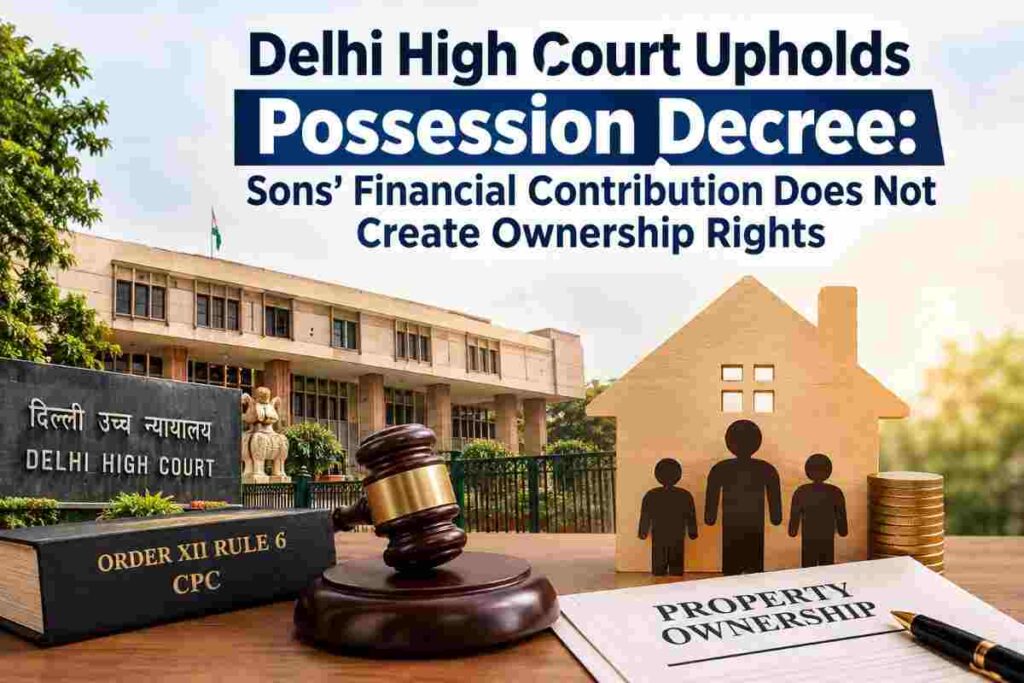
The Delhi High Court has clarified an important principle concerning decrees on admissions under Order XII Rule 6 of the Code of Civil Procedure, 1908 (CPC). In Anil Kumar & Anr. v. Rangi Lal, the Court upheld a decree directing two sons to hand over possession of the Ground Floor and First Floor of a property owned by their father.
The dispute arose from a family property at Kewal Park, Azadpur, Delhi. The father, Rangi Lal, was the registered owner of the property. His sons, Anil Kumar and Ram Ashish, were permitted to reside on different floors. After relations deteriorated, the father terminated their permission to occupy the property and instituted a suit for possession.
The sons resisted the claim, principally arguing that they had financially contributed towards construction and renovation of the property and therefore had rights and interests in it. They also disputed that they were licensees and subsequently claimed that the property was ancestral.
The Delhi High Court rejected these contentions. It held that the sons had repeatedly admitted their father’s ownership and had failed to plead any legally recognised basis by which their alleged financial contributions could create a proprietary interest in the property. The Court consequently found that there was no genuine triable issue preventing a decree on admissions.
The judgment also provides a detailed explanation of Section 60(b) of the Indian Easements Act, 1882, holding that merely contributing money towards construction does not make a licence irrevocable.
Case Details
| Particular | Details |
|---|---|
| Case Name | Anil Kumar & Anr. v. Rangi Lal |
| Court | High Court of Delhi at New Delhi |
| Case Number | RFA 315/2025, CM APPL. 19777/2025 |
| Judgment Date | 10 September 2026 |
| Bench | Justice Neena Bansal Krishna |
| Provision for Appeal | Section 96, CPC |
| Key Provision | Order XII Rule 6, CPC |
| Other Statute | Indian Easements Act, 1882, Sections 52 and 60(b) |
| Impugned Order | Order and Preliminary Decree dated 27 July 2024 |
The judgment records that the appeal was filed under Section 96 CPC against the order and preliminary decree by which the trial court had granted possession of the Ground Floor and First Floor to the plaintiff and restrained the defendants from interfering with peaceful enjoyment or creating third-party interests.
Background and Facts of the Case
Rangi Lal was the registered owner of Property No. 180-A, Kewal Park, Azadpur, Delhi, measuring 50 square yards. He had purchased the property from Satish Garg and Santosh Garg through a registered Sale Deed dated 29 March 2004.
According to Rangi Lal, the property was purchased from his own funds, including a loan, and was subsequently constructed up to the Third Floor. He maintained that neither of his sons had contributed towards the purchase or construction of the property.
After their respective marriages, Anil Kumar was permitted to reside on the Ground Floor and Ram Ashish on the First Floor. The father described their occupation as permissive, in the nature of a licence.
Relations between the parties subsequently deteriorated. The father alleged that his sons quarrelled with him, used abusive language and subjected him to threats and assaults. He eventually severed his relations with them and published notices disowning and debarring them from his movable and immovable properties.
A legal notice dated 18 November 2019 terminated their permission to occupy the Ground Floor and First Floor with effect from 20 November 2019. When the sons did not vacate, the father instituted a suit seeking possession, permanent injunction and mesne profits/damages.
What Was the Defence of the Sons?
The sons did not dispute that the registered Sale Deed stood in their father’s name. However, they argued that their financial contributions towards the property gave them rights and interests in it.
Anil Kumar claimed that he had been working since 2004 and had handed over his earnings to his father, which were allegedly used for construction. He also claimed that he had contributed towards construction of the Second and Third Floors and had incurred expenditure towards his younger brother’s marriage.
Ram Ashish similarly claimed that he had handed over his earnings to his father and that these amounts were utilised towards construction and renovation. He relied upon these alleged contributions to claim an interest in the property.
The defendants also denied that they were licensees, contending that there was no written licence agreement. Later, they asserted that the property was ancestral and that they consequently possessed rights in it.
Procedural History
During the pendency of the suit, Rangi Lal moved an application under Order XII Rule 6 CPC, seeking a decree on the basis of admissions contained in the defendants’ pleadings.
The plaintiff relied particularly on the defendants’ repeated acknowledgment that the registered Sale Deed stood in his favour and that he was the owner of the property.
The District Judge accepted this position. On 27 July 2024, the court granted a decree of possession of the Ground Floor and First Floor along with a permanent injunction. However, the claim for damages/mesne profits was left for evidence because the alleged financial contributions and the appropriate amount of damages required adjudication.
The sons then challenged the decree before the Delhi High Court.
Legal Issues Before the Delhi High Court
The principal question before the Court was:
Whether the admissions contained in the defendants’ pleadings were sufficiently clear and unequivocal to justify a decree of possession under Order XII Rule 6 CPC?
The Court also considered related questions:
- Whether the sons’ alleged financial contributions created a proprietary interest in the property.
- Whether their claim that the property was ancestral raised a genuine triable issue.
- Whether the absence of a written licence agreement prevented the Court from treating their occupation as permissive.
- Whether Section 60(b) of the Indian Easements Act made the alleged licence irrevocable.
- Whether issues having already been framed in the suit prevented the Court from exercising jurisdiction under Order XII Rule 6 CPC.
Arguments of the Appellants
The sons argued that the trial court had mechanically exercised jurisdiction under Order XII Rule 6 CPC.
Their principal submission was that the Written Statement had to be read as a whole. According to them, their acknowledgment of the registered Sale Deed could not be isolated from their other defences, particularly their assertions concerning financial contribution and the nature of their possession.
They argued that their alleged contributions towards construction and renovation gave rise to rights requiring adjudication through evidence. They also disputed the existence of a licensor-licensee relationship because no written licence agreement had been produced.
Reliance was placed on Razia Begum v. Sahebzadi Anwar Begum, S.M. Asif v. Virender Kumar Bajaj and Vijay Kumar Jain v. Suresh Kumar Jain to contend that the power under Order XII Rule 6 CPC is discretionary and should not be exercised where a genuine issue requiring evidence survives.
The appellants additionally invoked Section 60(b) of the Indian Easements Act, contending that permanent construction allegedly made with their financial contribution rendered the licence irrevocable.
Arguments of the Respondent
Rangi Lal supported the trial court’s decision and argued that the defendants had clearly admitted his ownership.
According to the plaintiff, the repeated admissions concerning the registered Sale Deed and his status as the absolute owner eliminated the need for a trial concerning his title.
The plaintiff therefore maintained that once ownership was admitted and the defendants could not demonstrate an independent legal right to remain in possession, a decree under Order XII Rule 6 CPC was justified.
Court’s Analysis and Reasoning
1. Repeated admissions of ownership were clear and categorical
The High Court placed considerable emphasis on the defendants’ own pleadings.
The defendants had acknowledged the registration of the Sale Deed in favour of their father. More importantly, in another part of their Written Statement they expressly described the plaintiff as the “absolute owner” of the property.
The same position was repeated in their response to the Order XII Rule 6 application. The Court therefore found that the admission was not an isolated or ambiguous statement but had been made repeatedly across the pleadings.
The Court concluded that these admissions left little ambiguity concerning ownership.
2. Financial contribution does not automatically create ownership
This was one of the most significant aspects of the judgment.
The sons claimed that they had contributed their earnings towards construction and renovation. The Court held that even if such contribution were accepted at its highest, the defendants had not pleaded any joint acquisition, transfer, conveyance, family arrangement or other legal arrangement through which proprietary rights were created in their favour.
The Court distinguished between proving that money was contributed and proving that the contribution created a legal proprietary interest.
In other words, financial contribution and ownership are not legally synonymous. A person may contribute money towards construction of another person’s property without thereby becoming a co-owner.
The Court also noted that the defendants had not provided specific details of the alleged contributions, such as the amount contributed and when the amounts were given.
3. The ancestral-property argument was unsupported
The defendants also argued that the property was ancestral.
The Court rejected this contention because the property had admittedly been purchased by the plaintiff from third parties through a registered Sale Deed dated 29 March 2004.
The Court explained that simply describing property as ancestral is insufficient. The party making such a claim must provide the necessary factual foundation concerning the ancestor from whom the property devolved and the manner in which it acquired ancestral character.
No such foundation had been pleaded by the defendants.
The Court therefore held that the bald assertion of ancestral character could not create a triable issue contrary to the admitted documentary record.
4. A written licence agreement is not essential to establish permissive possession
The defendants argued that they could not be treated as licensees because there was no written Licence Agreement.
The High Court rejected this approach.
It held that the absence of a formal written instrument is not by itself determinative of the nature of possession. On the facts, the sons had been permitted to reside in specific portions of their father’s property with their families.
Their possession was therefore found to be permissive, in the nature of a licence.
5. Section 60(b) did not make the licence irrevocable
The Court then examined the argument based on Section 60(b) of the Indian Easements Act, 1882.
Section 52 defines a licence as permission to do something upon another person’s immovable property which would otherwise be unlawful, without creating an interest in the property.
The Court emphasised that a licence is fundamentally permissive and does not itself create a proprietary interest. Ordinarily, therefore, it remains revocable unless one of the statutory exceptions applies.
Section 60(b) provides an exception where the licensee, acting upon the licence, has executed a work of a permanent character and incurred expenses in its execution.
The Court identified three essential requirements:
- The licensee must have executed a work of a permanent character.
- The work must have been executed “acting upon the licence”, within the scope of the permission and with the licensor’s knowledge and consent.
- The licensee must have incurred expenses in executing the work.
The absence of any one of these conditions defeats the claim of irrevocability.
The Court relied upon Shankar Gopinath Apte v. Gangabai Hariharrao Patwardhan, Ram Sarup Gupta v. Bishun Narain Inter College and Mumbai International Airport Pvt. Ltd. v. Golden Chariot Airport in explaining these principles.
Applying the law to the present case, the Court found that the defendants had not pleaded that their father permitted them, as licensees, to execute particular permanent works.
Their case was merely that their earnings were handed over to their father and were used towards construction and renovation.
That was insufficient to invoke Section 60(b). The alleged financial contribution could not be equated with execution of permanent work by the licensees acting pursuant to the licence.
6. Framing of issues did not prevent a decree under Order XII Rule 6
The appellants also argued that issues had already been framed on 2 August 2023 and therefore the matter necessarily had to proceed to trial.
The High Court rejected this as an absolute proposition.
It held that the prior framing of issues does not by itself prevent a court from exercising jurisdiction under Order XII Rule 6 CPC. The relevant question is whether, after considering the pleadings as a whole, a genuine triable issue survives concerning the relief proposed to be decreed.
Since no such issue survived concerning the plaintiff’s entitlement to possession, the framing of issues did not prevent the possession decree.
Judgment and Final Decision
The Delhi High Court found that the plaintiff’s ownership was expressly and repeatedly admitted by the defendants.
The Court further held that the defendants had failed to establish any independent right, title or interest that entitled them to remain in possession after the permission to occupy the property had been withdrawn.
The appeal was therefore dismissed, and the trial court’s order and preliminary decree of possession and permanent injunction dated 27 July 2024 were left undisturbed.
The Court thus upheld the plaintiff’s entitlement to recover possession of the Ground Floor and First Floor and to restrain the defendants from creating third-party interests in those portions.
Ratio Decidendi
The core principle emerging from the judgment is that where defendants repeatedly and unequivocally admit the plaintiff’s ownership of immovable property, and fail to plead a legally recognised independent right to remain in possession, the Court can grant possession under Order XII Rule 6 CPC despite the existence of other disputed factual assertions.
A claim that a son financially contributed towards construction or renovation of his father’s property does not, by itself, create ownership or a proprietary interest. There must be a pleaded legal foundation demonstrating how such an interest was created.
Similarly, where occupation is permissive, mere expenditure or contribution towards property-related construction does not make a licence irrevocable under Section 60(b) of the Indian Easements Act unless the statutory requirements are satisfied.
Important Legal Provisions
Order XII Rule 6 CPC
Order XII Rule 6 enables a court to pronounce judgment on admissions where the relevant facts necessary for the relief have been admitted.
In this case, the High Court focused on whether the admissions concerning ownership were sufficiently clear and unequivocal. It concluded that they were, particularly because the defendants repeatedly acknowledged their father’s absolute ownership.
Section 96 CPC
Section 96 CPC provides the statutory basis for a regular first appeal against an original decree. The present proceedings were instituted under this provision to challenge the trial court’s preliminary decree.
Section 52, Indian Easements Act, 1882
Section 52 defines a licence as permission to do or continue to do something upon immovable property which would otherwise be unlawful, without creating an interest in that property.
The Court relied on the non-proprietary nature of a licence in rejecting the defendants’ attempt to derive ownership from their permissive occupation.
Section 60(b), Indian Easements Act, 1882
Section 60(b) creates a limited exception to the general revocability of a licence where the licensee has, acting upon the licence, executed a permanent work and incurred expenses in doing so.
The Court stressed that all statutory requirements must be established before the exception can apply.
Important Precedents
| Case | Legal Principle | How It Was Used |
|---|---|---|
| Razia Begum v. Sahebzadi Anwar Begum & Ors., 1959 SCR 1111 | Admissions do not necessarily compel a court to dispense with proof in every circumstance. | Relied upon by appellants regarding discretion concerning admissions. |
| S.M. Asif v. Virender Kumar Bajaj, (2015) 9 SCC 287 | Order XII Rule 6 is discretionary and should not ordinarily be used where issues requiring evidence go to the root of the matter. | Cited by appellants in challenging the possession decree. |
| Vijay Kumar Jain v. Suresh Kumar Jain, 2022 SCC OnLine Del 2229 | Courts must be conscious that a decree on admissions may deprive a party of a trial on an issue requiring adjudication. | Relied upon by appellants. |
| C.N. Arunachala Mudaliar v. C.A. Muruganatha Mudaliar, AIR 1953 SC 495 | The nature of property depends upon the mode by which it was acquired, not merely the relationship between the parties. | Applied in rejecting the ancestral-property argument. |
| Govindbhai Chhotabhai Patel v. Patel Ramanbhai Mathurbhai, Civil Appeal No. 7528/2019 | The party asserting ancestral character bears the burden of establishing it. | Applied against the defendants’ unsupported ancestral-property plea. |
| Shankar Gopinath Apte v. Gangabai Hariharrao Patwardhan, (1976) 4 SCC 112 | “Acting upon the licence” requires the permanent work to have been undertaken in the capacity of licensee. | Applied to Section 60(b). |
| Ram Sarup Gupta v. Bishun Narain Inter College, (1987) 2 SCC 555 | Permanent construction must have a direct nexus with the licence. | Used to assess the alleged construction. |
| Mumbai International Airport Pvt. Ltd. v. Golden Chariot Airport, (2010) 10 SCC 422 | Mere expenditure or investment does not automatically make a licence irrevocable. | Applied to reject the appellants’ Section 60(b) argument. |
These authorities are the precedents specifically discussed in the judgment.
What Does This Judgment Mean?
For Property Litigants
The judgment demonstrates the importance of carefully framing pleadings. A party cannot simultaneously acknowledge another person’s absolute ownership and then rely upon vague assertions of contribution to create a proprietary right.
For Parents and Property Owners
The decision reinforces that permitting adult children to occupy portions of a property does not, by itself, transfer ownership or create a permanent right of occupation. Where possession is permissive, withdrawal of that permission may have legal consequences, subject to the facts and applicable law.
For Lawyers
The decision is particularly relevant when considering an application under Order XII Rule 6 CPC. The pleadings must be examined as a whole, but courts need not send every dispute to trial merely because some factual assertions are contested.
The critical inquiry is whether a genuine triable issue survives concerning the specific relief sought.
For Law Students
The case provides a useful illustration of the distinction between:
- admission of title and disputed possession;
- contribution and proprietary ownership;
- licence and ownership;
- revocable and irrevocable licences; and
- a genuine triable issue and a merely bald assertion.
Key Takeaways
- Repeated admissions of ownership can justify a decree under Order XII Rule 6 CPC.
- A Written Statement must be read as a whole, but unsupported pleas cannot automatically defeat clear admissions.
- Financial contribution towards construction does not, by itself, create co-ownership.
- A party claiming ancestral property must establish the factual foundation for that claim.
- A written licence agreement is not necessarily essential to establish permissive occupation.
- A licence is fundamentally a personal and non-proprietary permission.
- Section 60(b) requires strict satisfaction of its statutory ingredients.
- Mere expenditure or financial contribution does not automatically make a licence irrevocable.
- Framing of issues does not create an absolute bar against invoking Order XII Rule 6 CPC.
- The existence of a triable issue must be assessed in relation to the relief sought.
Frequently Asked Questions
1. What is the Anil Kumar v. Rangi Lal judgment?
The Delhi High Court upheld a possession decree in favour of Rangi Lal, the registered owner of the property, after finding that his sons had repeatedly admitted his ownership and had failed to establish an independent legal right to remain in possession.
2. What did the Delhi High Court hold about Order XII Rule 6 CPC?
The Court held that clear and repeated admissions of ownership can justify a decree on admissions where the defendant does not disclose a genuine triable issue concerning the relief sought.
3. Can a son become a co-owner by contributing money to his father’s property?
Not merely because he contributed money. The Court held that financial contribution, without a pleaded legal foundation creating proprietary rights, does not itself make a son a co-owner.
4. What is Section 60(b) of the Indian Easements Act?
Section 60(b) is an exception to the general revocability of a licence. It can apply where the licensee, acting upon the licence, executes permanent work and incurs expenses in doing so.
5. Does construction expenditure automatically make a licence irrevocable?
No. The Court held that mere expenditure or contribution is insufficient. The statutory requirements of Section 60(b), including the necessary connection between the work and the licence, must be established.
6. Can an adult son claim ancestral rights merely because the property belongs to his father?
Not on that basis alone. The party claiming ancestral character must establish the factual and legal basis for that claim. The Court rejected the defendants’ unsupported assertion in this case.
7. Is a written licence agreement necessary for permissive possession?
Not necessarily. The Delhi High Court held that the absence of a formal written licence instrument is not by itself determinative of the nature of possession.
8. Does framing of issues prevent a decree under Order XII Rule 6 CPC?
No. The Court held that prior framing of issues is not an absolute bar. The relevant question is whether a genuine triable issue survives in relation to the relief being sought.
9. What was the final decision in the case?
The Delhi High Court dismissed the appeal and upheld the trial court’s decree of possession and permanent injunction.
10. Why is this judgment important?
The judgment is important because it clarifies the limits of relying upon alleged financial contribution, ancestral-property assertions and Section 60(b) of the Easements Act to resist a possession claim where ownership has repeatedly been admitted.
Conclusion
The Delhi High Court’s decision in Anil Kumar & Anr. v. Rangi Lal highlights the importance of the legal foundation of a property claim. A defendant cannot convert an alleged financial contribution into a proprietary interest merely by asserting that money was spent on construction or renovation.
The judgment also demonstrates how admissions in pleadings can become decisive. Here, the sons repeatedly acknowledged their father’s ownership, while failing to identify any conveyance, family arrangement, joint acquisition or other legal mechanism that could have created ownership rights in their favour.
The Court’s treatment of Section 60(b) is equally significant. A claim of irrevocability requires satisfaction of the statutory conditions; mere investment or expenditure is not enough.
Ultimately, the judgment reinforces a practical proposition in civil litigation: where ownership is admitted and no legally sustainable independent right to possession is pleaded, the existence of peripheral factual disputes does not necessarily require the entire possession claim to proceed to trial. The appeal was accordingly dismissed and the decree of possession and permanent injunction was upheld.