
Introduction
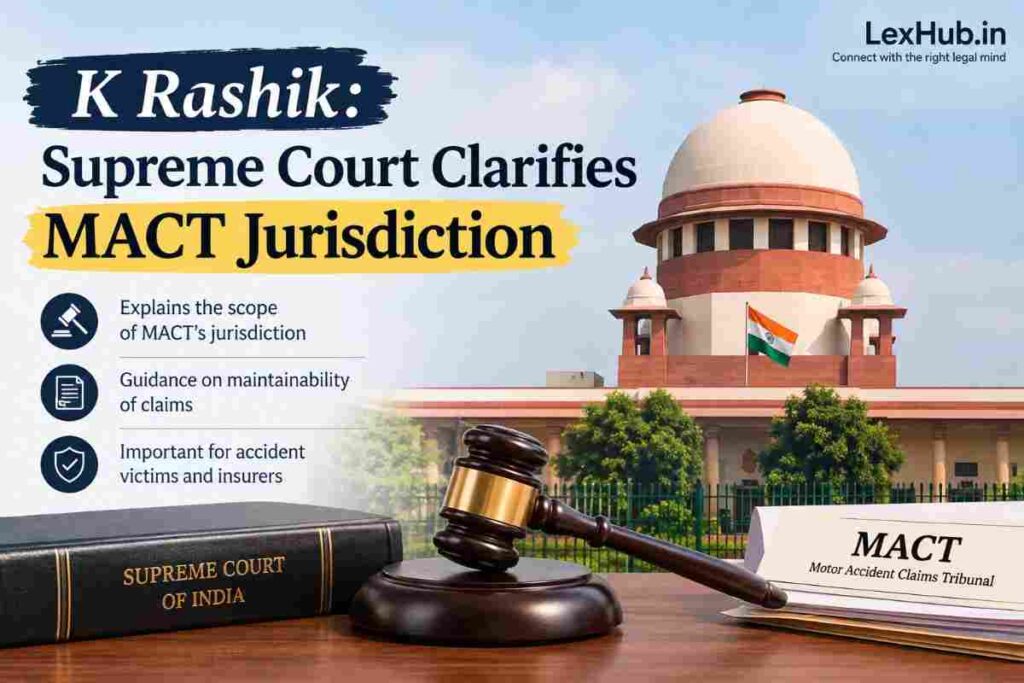
The Supreme Court of India has clarified an important question concerning the territorial jurisdiction of Motor Accidents Claims Tribunals (MACTs) under Section 166(2) of the Motor Vehicles Act, 1988. In K Rashik v. National Insurance Company Ltd. and Another, the Court examined whether a compensation claim could be maintained before the Claims Tribunal at Chennai merely because the insurer had an office there.
The accident in the case occurred in Tirupati District, Andhra Pradesh. The claimant’s address in the claim application was also in Chittoor District, Andhra Pradesh. However, the claim petition was filed before the Motor Accidents Claims Tribunal at Chennai. The insurer objected to the territorial jurisdiction of the Chennai Tribunal.
The Supreme Court held that the objection was well founded. It explained that Section 166(2) provides specific statutory bases for territorial jurisdiction and that the place where an insurer carries on business is not, by itself, a jurisdictional ground under that provision.
The Court ultimately upheld the Madras High Court’s decision transferring the proceedings from Chennai to Chittoor.
Case Details
| Particular | Details |
|---|---|
| Case Name | K Rashik v. National Insurance Company Ltd. and Another |
| Court | Supreme Court of India |
| Case Number | Civil Appeal No. 10706 of 2026 |
| Citation | 2026 INSC 996 |
| Judgment Date | 16 September 2026 |
| Bench | Ujjal Bhuyan and Atul S. Chandurkar, JJ. |
| Statute | Motor Vehicles Act, 1988 |
| Key Provision | Section 166(2) |
| Other Provisions Considered | Sections 166, 168 and 169 of the Motor Vehicles Act; Section 21 of the Code of Civil Procedure, 1908 |
| Final Result | Civil Appeal dismissed; proceedings to continue before the Tribunal at Chittoor |
The judgment is reported as 2026 INSC 996 and was delivered in Civil Appeal No. 10706 of 2026.
Background and Facts of the Case
On 25 October 2022, K Rashik was travelling on a two-wheeler with his brother when a mini truck collided with the vehicle. The accident occurred at Thatimaakulapalli Cross Road on the Nerabaillu-Yerravaripalem road in Y.V. Palem Mandal, District Tirupati, Andhra Pradesh.
Following the accident, Rashik received inpatient treatment at a hospital in Tirupati. His brother lodged an FIR at Yerravaripalem Police Station in District Tirupati.
Rashik subsequently filed a compensation claim under Section 166 of the Motor Vehicles Act, 1988, before the Motor Accidents Claims Tribunal at Chennai.
The insurer, National Insurance Company Ltd., objected to the territorial jurisdiction of the Chennai Tribunal. It argued that no part of the cause of action had arisen in Chennai and therefore Section 166(2) did not confer jurisdiction on the Chennai Tribunal.
The Tribunal at Chennai rejected the objection on 11 July 2025, holding that it had jurisdiction because the insurer also carried on business at Chennai.
The insurer challenged that order before the Madras High Court under Article 227 of the Constitution. On 16 March 2026, the High Court held that the Tribunal at Chittoor had jurisdiction because the accident had occurred in Andhra Pradesh and set aside the Chennai Tribunal’s order.
Rashik then approached the Supreme Court.
What Were the Arguments of the Parties?
Claimant’s Arguments
The claimant argued that the Chennai Tribunal had jurisdiction because he was residing and working in Chennai. Reliance was placed principally on Sections 166 and 169 of the Motor Vehicles Act.
It was also argued that the Motor Vehicles Act is beneficial legislation and should therefore be interpreted in a manner that protects accident victims. According to the claimant, the insurer had an office at Chennai and would suffer no prejudice if the claim was adjudicated there.
The claimant relied upon the Calcutta High Court decision in National Insurance Co. Ltd. v. Alpana Jana & Others.
Insurer’s Arguments
The insurer argued that the accident had occurred in Tirupati District and that the claimant’s address in the claim petition was also in Chittoor District.
According to the insurer, there was no pleading establishing that any part of the cause of action had arisen in Chennai. It therefore contended that the Chennai Tribunal lacked territorial jurisdiction under Section 166(2).
The insurer further argued that its presence or business office in Chennai could not independently confer territorial jurisdiction on the Tribunal.
Court’s Analysis and Reasoning
Can an Insurer Object to the Territorial Jurisdiction of the MACT?
Yes. The Supreme Court held that when the insurer is impleaded as a defendant in a Section 166 claim, it can raise a permissible objection concerning territorial jurisdiction.
The Court first considered the claimant’s argument that the insurer should not be permitted to object because it had an office at Chennai.
The Court rejected that submission. It relied upon the three-Judge Bench decision in United India Insurance Co. Ltd. v. Shila Datta & Others, reported as 2011 INSC 759.
The principle emerging from Shila Datta, as applied by the Supreme Court, is that an insurer voluntarily impleaded as a party-respondent is not confined to the limited grounds available to an insurer that is merely a noticee. Once impleaded as a party, the insurer can raise all grounds available to a respondent.
In the present case, the claimant himself had impleaded the insurer as a defendant. Consequently, the insurer was entitled to challenge the territorial jurisdiction of the Chennai Tribunal.
What Does Section 166(2) Say About Territorial Jurisdiction?
Section 166(2) gives the claimant specified options for filing a motor accident compensation claim.
The provision permits the application to be filed before the Claims Tribunal having jurisdiction over:
- The area where the accident occurred;
- The area where the claimant resides;
- The area where the claimant carries on business; or
- The local limits where the defendant resides.
The Supreme Court emphasised the language used by Parliament in Section 166(2). In particular, the provision refers to the place where the claimant resides or carries on business, whereas, concerning the defendant, it refers only to where the defendant resides.
The distinction in wording was significant to the Court’s interpretation.
Does the Insurer’s Place of Business Give the MACT Jurisdiction?
Not under Section 166(2) merely because the insurer has an office or carries on business there.
The Supreme Court specifically distinguished the statutory language applicable to the claimant and defendant.
For the claimant, Section 166(2) expressly includes both residence and carrying on business. For the defendant, however, the provision refers to where the defendant resides.
The Court observed that the legislature could have included the defendant’s place of business but did not do so.
The Court also contrasted Section 166(2) with Section 20 of the Code of Civil Procedure, 1908, under which the place where a defendant carries on business can be relevant to territorial jurisdiction in an ordinary civil suit.
That broader criterion found in Section 20 CPC is not reproduced in Section 166(2) of the Motor Vehicles Act.
Why Is an Insurer Not Treated as the “Defendant” for This Purpose?
The Court further examined whether the word “defendant” in Section 166(2) could include the insurer.
It concluded that the expression does not refer to the insurer in the circumstances of this statutory scheme.
One reason is that impleading an insurer as a defendant is not mandatory. The claimant can maintain a claim against the owner and driver without necessarily impleading the insurer.
Further, Section 168(1) requires the Tribunal to give notice of a Section 166 claim to the insurer. Thus, an insurer can become aware of the proceedings even when it has not been impleaded as a party.
The Court therefore considered the owner and/or driver to be the principal contesting defendants for purposes of the territorial-jurisdiction provision.
Section 166(2) and Section 21 CPC: Why the Stage of Objection Matters
An important aspect of the judgment concerns the difference between an objection raised at the beginning of proceedings and one raised at the appellate or later stage.
The Supreme Court explained that when an objection to territorial jurisdiction is raised before the Tribunal at the initial stage, Section 166(2) governs the question. The claimant must satisfy one of the statutory jurisdictional requirements.
However, when the objection is raised after the award, particularly at the appellate stage, Section 21(1) CPC becomes relevant.
At that later stage, merely demonstrating lack of territorial jurisdiction is insufficient. The party raising the objection must also establish that the exercise of jurisdiction resulted in a failure of justice.
Thus, the Court drew an important distinction based on the stage at which the jurisdictional objection is considered.
Previous Supreme Court Decisions Considered
The Court discussed several earlier decisions concerning territorial jurisdiction.
| Case | Legal Principle | Use in the Present Judgment |
|---|---|---|
| United India Insurance Co. Ltd. v. Shila Datta & Others | An insurer impleaded as a party-respondent can raise all grounds available to it. | Used to hold that the insurer could challenge territorial jurisdiction. |
| Mantoo Sarkar v. Oriental Insurance Co. Ltd. & Others | Territorial jurisdiction and claimant residence must be examined under Section 166(2); Section 21 CPC becomes relevant at the appellate stage. | Distinguished because the jurisdiction objection arose at the appellate stage. |
| Malati Sardar v. National Insurance Company Ltd. & Others | At the appellate stage, an objection to territorial jurisdiction is subject to Section 21 CPC and failure-of-justice considerations. | Distinguished on the basis of the stage at which the objection was raised. |
| Balveer Batra v. The New India Assurance Company & Another | Once a Tribunal concludes that it lacks territorial jurisdiction, it should not proceed to decide the other issues. | Considered in explaining the treatment of territorial jurisdiction objections. |
The judgment specifically discusses these authorities in its analysis of the relationship between Section 166(2) and Section 21 CPC.
How Did the Supreme Court Apply Section 166(2) to the Present Case?
The Court examined the actual pleadings in the claim application.
The claim petition showed:
- The accident occurred in District Tirupati, Andhra Pradesh.
- The claimant’s pleaded address was in Chittoor District, Andhra Pradesh.
- There was no pleading that the claimant carried on business elsewhere.
- The driver of the offending vehicle was also stated to reside in Chittoor District.
- There was no pleading establishing that any part of the cause of action arose within Chennai.
On these facts, none of the jurisdictional bases under Section 166(2) connected the claim with the Chennai Tribunal.
The fact that the insurer had its office at Chennai did not independently satisfy Section 166(2).
Beneficial Legislation and Statutory Language
The claimant had argued that the Motor Vehicles Act should receive a beneficial interpretation because it is intended to address the hardships caused by motor vehicle accidents.
The Supreme Court accepted the importance of the Act’s beneficial objectives but clarified that a purposive interpretation cannot disregard the statutory language.
The Court held, in substance, that an interpretation must have statutory support. Where the plain language of the legislation provides the relevant jurisdictional criteria, that language must be respected.
This part of the judgment is significant because it illustrates the relationship between beneficial interpretation and the limits imposed by the statutory text.
Judgment and Final Decision
The Supreme Court upheld the Madras High Court’s order dated 16 March 2026.
It confirmed that the Chennai Tribunal did not possess territorial jurisdiction over the claim on the facts pleaded.
The proceedings were therefore directed to continue before the Tribunal at Chittoor, where the claim was to be adjudicated expeditiously in accordance with law.
The Civil Appeal was dismissed with no order as to costs, and the pending interlocutory application was also disposed of.
Ratio Decidendi
The core principle of K Rashik v. National Insurance Company Ltd. is that territorial jurisdiction for a claim under Section 166 of the Motor Vehicles Act must be determined according to the specific alternatives prescribed by Section 166(2).
The provision permits filing at the place of accident, where the claimant resides, where the claimant carries on business, or where the defendant resides. The provision does not confer territorial jurisdiction merely because an insurer impleaded in the claim carries on business or maintains an office at a particular place.
Further, where the territorial-jurisdiction objection is raised at the initial stage before the Tribunal, Section 166(2) governs. The failure-of-justice requirement under Section 21(1) CPC becomes relevant when such an objection is pursued at the appellate or later stage.
Important Legal Provisions
Section 166(2), Motor Vehicles Act, 1988
This provision determines where an application for compensation can be filed. It gives the claimant specified territorial options connected with the accident, the claimant’s residence or business, and the defendant’s residence.
In this case, the Supreme Court relied heavily on the precise difference between the expressions used for the claimant and defendant.
Section 168(1), Motor Vehicles Act, 1988
The provision requires the Claims Tribunal to give notice of a Section 166 application to the insurer. This supported the Court’s conclusion that the insurer need not necessarily be treated as the “defendant” for purposes of Section 166(2).
Section 169, Motor Vehicles Act, 1988
Section 169 concerns the procedure before the Claims Tribunal. The judgment notes that the Tribunal follows a summary procedure and possesses certain powers of a Civil Court.
Section 21(1), Code of Civil Procedure, 1908
Section 21 becomes relevant where an objection to territorial jurisdiction is raised at a later or appellate stage. The Court explained that, in such circumstances, the objecting party must establish the requisite failure of justice in addition to having raised the jurisdictional objection.
What Does This Judgment Mean for Motor Accident Claimants?
The judgment makes the statutory jurisdictional requirements particularly important at the initial filing stage.
A claimant cannot rely solely on the fact that an insurer has an office in the place where the claim is filed. The claim application should disclose the factual basis connecting the chosen Tribunal to one of the jurisdictional alternatives in Section 166(2).
For lawyers, this places importance on carefully examining and pleading the claimant’s residence, place of business, location of the accident and residence of the relevant defendant before filing the claim.
For insurers impleaded as party-respondents, the judgment confirms that a territorial-jurisdiction objection can be raised where legally available.
For law students and judiciary aspirants, the decision is particularly relevant to the distinction between Section 166(2) of the Motor Vehicles Act and Section 21 CPC.
Key Takeaways
- Section 166(2) governs territorial jurisdiction for motor accident compensation claims.
- A claimant has statutory options concerning the place of accident, claimant’s residence, claimant’s business and defendant’s residence.
- The defendant’s place of business is not expressly included in Section 166(2).
- An insurer’s office at a particular place does not, by itself, confer MACT jurisdiction there.
- An insurer voluntarily impleaded as a party-respondent can raise permissible objections, including territorial jurisdiction.
- The stage at which a territorial objection is raised is important.
- Section 166(2) applies when the objection is considered at the initial stage.
- Section 21 CPC becomes relevant to objections raised at the appellate or later stage.
- At the later stage, failure of justice must be demonstrated as required under Section 21.
- Beneficial interpretation of the Motor Vehicles Act cannot override the plain statutory language.
Frequently Asked Questions
What is the K Rashik v. National Insurance Company judgment?
It is a Supreme Court judgment concerning the territorial jurisdiction of a Motor Accidents Claims Tribunal under Section 166(2) of the Motor Vehicles Act, 1988. The Court held that the Chennai Tribunal lacked jurisdiction on the facts of the case and upheld transfer of the claim proceedings to Chittoor.
What did the Supreme Court hold about Section 166(2)?
The Court held that Section 166(2) provides specific territorial options for filing a motor accident compensation claim. These include the place of accident, claimant’s residence, claimant’s place of business and defendant’s residence.
Can an MACT claim be filed where the insurer has an office?
The Supreme Court held in this case that the insurer’s place of business does not, by itself, confer territorial jurisdiction under Section 166(2) of the Motor Vehicles Act.
Can an insurer object to the territorial jurisdiction of a Claims Tribunal?
Yes. Where the insurer has been impleaded as a party-respondent, the Supreme Court held that it can raise permissible grounds, including an objection to territorial jurisdiction.
Does Section 166(2) include the insurer as the defendant?
The Court held that the expression “defendant” in Section 166(2) does not refer to an insurer merely because the insurer has been impleaded. The statutory scheme principally contemplates the owner and/or driver as the contesting defendants.
What is the difference between Section 166(2) and Section 21 CPC?
Section 166(2) governs the statutory territorial options for filing a compensation claim. Section 21 CPC becomes relevant where a territorial-jurisdiction objection is considered at the appellate or later stage, including the requirement concerning failure of justice.
Why was the Chennai Tribunal held to lack jurisdiction?
The pleadings showed that the claimant resided in Chittoor District, the accident occurred in Tirupati District, and there was no pleading that the claimant carried on business elsewhere. The driver was also stated to reside in Chittoor District. No part of the cause of action was shown to have arisen in Chennai.
Where was the claim ultimately transferred?
The Supreme Court upheld the transfer of the proceedings from the Chennai Tribunal to the Tribunal at Chittoor.
Did the Supreme Court reject the beneficial nature of the Motor Vehicles Act?
No. The Court recognised the Act’s objective of addressing hardships resulting from motor vehicle accidents. However, it held that beneficial interpretation cannot be used to adopt an interpretation unsupported by the statutory language.
What is the main legal principle in K Rashik?
The main principle is that territorial jurisdiction under Section 166(2) must be established through one of the jurisdictional connections specified by the statute; an insurer’s place of business alone does not create jurisdiction.
Practical Significance
For claimants: The jurisdictional basis should be clearly established in the claim petition.
For advocates: The pleadings should specifically identify the statutory connection between the claimant, accident, defendant and chosen Tribunal.
For insurers: An insurer impleaded as a party-respondent can contest territorial jurisdiction where the statutory requirements are not satisfied.
For law students: The judgment provides a useful illustration of statutory interpretation, territorial jurisdiction, beneficial legislation and the distinction between Section 166(2) of the Motor Vehicles Act and Section 21 CPC.
For judiciary aspirants: The case is particularly useful for understanding why the stage at which a jurisdictional objection is raised can alter the applicable legal test.
Conclusion
The Supreme Court’s decision in K Rashik v. National Insurance Company Ltd. & Another clarifies that territorial jurisdiction in motor accident compensation claims must be determined strictly in accordance with Section 166(2) of the Motor Vehicles Act, 1988. The mere existence of an insurer’s office at a particular place does not, by itself, confer jurisdiction upon the Claims Tribunal there.
The Court also highlighted the importance of the stage at which a territorial objection is raised. Where the objection is taken at the initial stage, the statutory requirements of Section 166(2) must be satisfied. A beneficial interpretation of the Motor Vehicles Act cannot, however, override the plain language of the statute.
In the present case, since the accident occurred in Tirupati District, the claimant resided in Chittoor District, and no jurisdictional connection with Chennai was established, the Supreme Court upheld the transfer of the proceedings to the Chittoor Claims Tribunal and dismissed the appeal.
Available next action: Create a downloadable PDF file here in this chat containing the finalized decisions and immediate actions above