
Introduction
Can a bank or financial institution repossess a financed vehicle merely because the borrower has defaulted on loan instalments? The Supreme Court has clarified that although a financier may have a contractual right to repossess a hypothecated vehicle, that right must be exercised strictly within the bounds of law, the loan agreement and applicable regulatory safeguards.
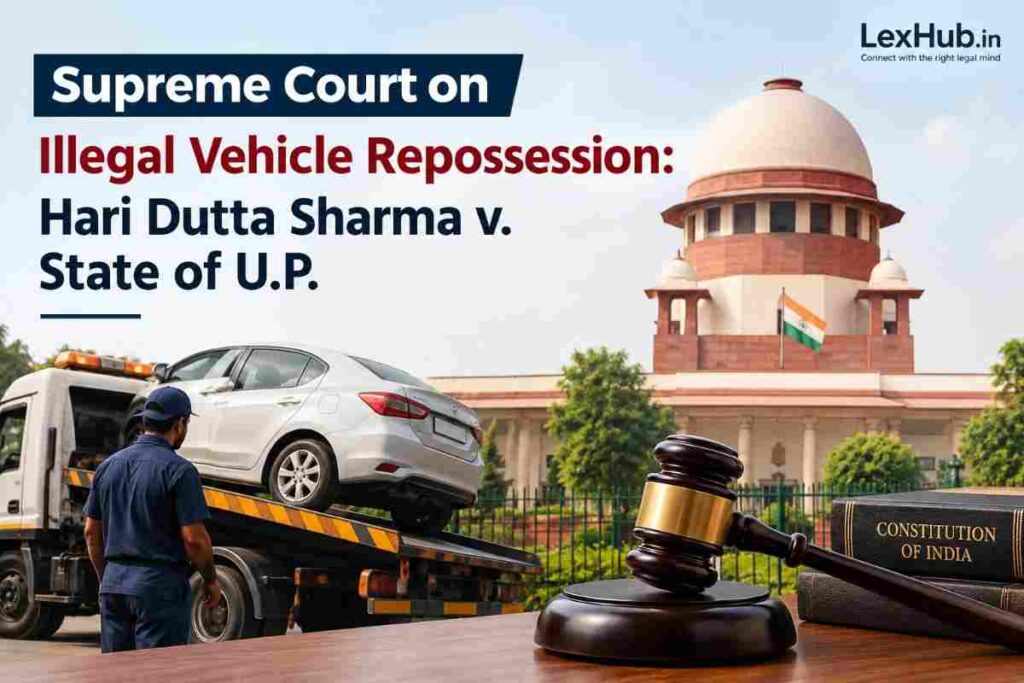
In Hari Dutta Sharma v. State of U.P. & Ors., the Supreme Court dealt with the repossession and subsequent sale of a commercial vehicle financed through a loan. The borrower alleged that the vehicle was taken away in the early hours of the morning by breaking its steering lock, without the seven-day notice contemplated by the loan agreement. The financier disputed this version and relied upon the borrower’s repeated defaults and the recovery steps taken by it.
The Supreme Court ultimately found that the repossession was unauthorised and arbitrary. It held that the relevant repossession clause itself was inconsistent with the RBI Guidelines and the requirements of fairness under the Indian Contract Act, 1872. The Court also held that the manner in which the appellant was deprived of the vehicle violated Articles 14 and 21 of the Constitution.
Although the vehicle had already been sold and the Court declined to set aside the sale at that stage, it directed the company to close both loan accounts, refund the entire sale price of ₹4,50,000 with 6% annual interest and pay ₹10 lakh as compensation for mental agony and loss of livelihood. Costs of ₹50,000 were also imposed.
Case Details
| Particular | Details |
|---|---|
| Case Name | Hari Dutta Sharma v. State of U.P. & Ors. |
| Court | Supreme Court of India |
| Judgment Date | 16 September 2026 |
| Bench | Justice Pamidighantam Sri Narasimha and Justice Alok Aradhe |
| Case Number | Civil Appeal No(s). of 2026 arising out of SLP (C) No(s). of 2026, Diary No. 10952 of 2026 |
| Impugned Order | Allahabad High Court order dated 04.04.2025 |
| Important Provisions | Article 14 and Article 21 of the Constitution; Section 35-A, Banking Regulation Act, 1949; Indian Contract Act, 1872 |
| Subject | Repossession of financed vehicle, recovery agents, RBI Guidelines and borrower protection |
The Supreme Court recorded the judgment as 2026 INSC 998 and delivered it on 16 September 2026.
Background and Facts of the Case
Commercial vehicle loan obtained by the appellant
On 25 March 2019, Hari Dutta Sharma obtained a commercial vehicle loan from Cholamandalam Investment and Finance Company Limited for purchasing a Tata SFC 407 truck bearing registration number UP-16-GT-0449.
The sanctioned loan amount was ₹10,40,080.75, out of which ₹9,36,000 was disbursed. The loan was repayable in 75 monthly instalments and was secured by hypothecation of the vehicle. A supplementary loan of ₹1,04,080.75 was subsequently extended on 12 June 2021.
Defaults in repayment
The appellant failed to make the instalment payments in accordance with the loan agreement. A recall-cum-demand notice was issued on 17 January 2022.
The company subsequently repossessed the vehicle and issued a pre-sale letter on 13 June 2022. At that stage, the appellant paid ₹86,726 and assured the company that he would regularise the loan account. The vehicle was consequently released.
The appellant again defaulted. Notices dated 7 July 2022 and 22 December 2022 were issued giving him an opportunity to clear the outstanding dues or surrender the hypothecated vehicle.
Disputed repossession of the vehicle
The central controversy arose on 9 April 2023.
According to the appellant, his truck was parked after delivery of goods at a consignor’s godown in Ayodhya and was under CCTV surveillance. At approximately 1:00 a.m., four unidentified persons allegedly broke the steering lock and drove the vehicle away.
The appellant stated that he had not received notice authorising such repossession. He lodged a lost article report and an e-FIR on the same day. He subsequently approached the Superintendent of Police on 8 September 2023, alleging that no effective action had been taken to trace the vehicle.
Sale of the vehicle
On 30 September 2023, the appellant received a legal notice from the company informing him that possession of the vehicle had been taken and that it had already been sold on 31 August 2023.
The company stated that the amount payable as on 31 August 2023 was ₹5,71,914 and that ₹4,50,000 had been recovered from the sale of the vehicle. The appellant was informed that ₹1,25,571 remained payable.
The appellant thereafter pursued criminal and writ remedies. His application under Section 156(3) of the Code of Criminal Procedure was dismissed, and the Allahabad High Court subsequently dismissed his writ petition, principally taking into account the delay and the appellant’s loan default.
Legal Issues Before the Supreme Court
The dispute raised several connected questions:
- Whether a financier can repossess a hypothecated vehicle without following the notice and procedural safeguards contained in the loan agreement.
- Whether a contractual right of self-help repossession permits the use of force or other unlawful means.
- Whether the repossession clause contained in the loan agreement was consistent with RBI Guidelines and the Indian Contract Act, 1872.
- Whether the High Court was justified in dismissing the writ petition merely on the ground of delay.
- Whether the appellant was entitled to compensation for the unlawful repossession and consequent loss of livelihood.
Arguments of the Parties
Appellant’s arguments
The appellant contended that the High Court had wrongly rejected his case on the ground of delay.
He relied upon Article 11 of the loan agreement and argued that it specifically required seven days’ prior notice before repossession. According to him, the financier’s contractual right of self-help repossession could not be exercised through force, deceit or in violation of the agreement.
The appellant also pointed out that traffic challans continued to be issued in respect of the vehicle even after the company claimed that it had sold the vehicle.
Company’s arguments
The company characterised the appellant as a chronic defaulter and relied upon the statement of account.
It also pointed out that an earlier repossession had been avoided after the appellant made part-payment and promised to regularise the account. The company contended that pre-seizure intimation, inventory, post-seizure intimation and pre-sale notice had been furnished.
According to the company, the vehicle had been sold for ₹4,50,000 and the sale was fair and consistent with the loan agreement.
Court’s Analysis and Reasoning
A financier has a contractual right to repossess, but the right is not unlimited
The Supreme Court began by recognising that a financier may have a contractual right to take possession of a financed vehicle.
The Court referred to Orix Auto Finance (India) Ltd. v. Jagmander Singh and Sundaram Finance Ltd. v. T. Thankam, observing that where the contract confers a right of repossession, there is ordinarily no legal impediment to its exercise unless the contractual provision is unconscionable or opposed to public policy.
However, the existence of such a contractual right does not mean that the financier can seize the vehicle by whatever method it chooses.
The Supreme Court emphasised that self-help repossession operates outside the immediate supervision of a court or tribunal. Therefore, it must be exercised with considerable care. A contractual repossession mechanism cannot become an unrestricted licence to seize property by stealth or force.
RBI Guidelines protect borrowers against coercive recovery practices
The Court examined the regulatory framework developed by the Reserve Bank of India.
Section 35-A of the Banking Regulation Act, 1949 empowers the RBI to issue directions to banking companies in specified circumstances, including public interest, banking policy, the interests of depositors and the interests of banking companies. The Court noted that directions issued under Section 35-A have statutory force and are binding on banking companies.
The RBI’s 2003 Fair Practices Code for Lenders specifically addressed recovery practices. It advised lenders not to resort to undue harassment of borrowers, including persistent contact at odd hours and the use of muscle power for recovery.
Subsequent RBI Guidelines and Fair Practices Codes applicable to NBFCs continued this approach and dealt with debt collection, recovery agents, customer rights, privacy, grievance redressal and repossession procedures.
Supreme Court’s earlier ruling in ICICI Bank v. Prakash Kaur
The Court relied significantly upon ICICI Bank Ltd. v. Prakash Kaur, where the Supreme Court had considered the use of recovery agents for forcibly taking possession of a vehicle.
The earlier judgment stressed that financial institutions must recover loans through legal means and cannot employ force for taking possession of vehicles.
The present judgment builds upon that principle by examining not merely the conduct of recovery agents but also the contractual repossession clause itself.
What must a lawful repossession framework contain?
The Supreme Court examined the successive RBI Master Circulars, Guidelines and Clarifications and identified several safeguards relevant to vehicle repossession.
These include:
- No undue harassment of borrowers.
- No use of muscle power.
- Seizure only through lawful means.
- Proper due diligence in appointing recovery agents.
- Legally valid repossession clauses.
- Compliance with the Indian Contract Act, 1872.
- Adherence by recovery agents to applicable regulatory guidelines.
- Serious consideration of complaints concerning abusive recovery practices.
- A proper notice period before repossession.
- A procedure for taking possession.
- A final opportunity to the borrower to clear the dues before sale or auction.
- A prescribed procedure for restoration of possession.
- A transparent procedure for sale or auction.
These safeguards demonstrate that default by itself does not eliminate the borrower’s entitlement to a lawful recovery process.
Why did the Supreme Court find Article 11 of the loan agreement problematic?
Article 11 of the agreement contained provisions concerning repossession, termination and sale of the vehicle.
Although it contemplated a seven-day notice, it also contained provisions allowing the company to waive notice where, in its opinion, such action could jeopardise the asset or its interests. It also gave the company broad powers concerning possession and sale of the vehicle.
The Supreme Court identified four major problems.
First: repossession without notice
The agreement stated that the borrower’s rights over the asset would stand determined automatically upon an event of default, without notice. The Court held that this conflicted with the requirement of a notice period before possession is taken.
Second: unrestricted power to enter places
The clause authorised the company to enter places where the vehicle might be found. The Supreme Court considered this inconsistent with the RBI framework requiring a fair and lawful procedure for taking possession.
Third: absence of a defined procedure
The clause did not prescribe a sufficiently defined procedure for taking possession or conducting the sale or auction. These matters were effectively left to the company’s discretion.
Fourth: unilateral waiver of notice
The Court was particularly concerned with the company’s ability to waive the notice requirement on its own assessment.
The Supreme Court held that a contractual term allowing one party to unilaterally remove procedural safeguards intended to protect the other party cannot be regarded as satisfying the required standard of fairness.
Was the actual repossession lawful?
The Supreme Court found that the actual repossession did not comply with either the loan agreement or the applicable RBI Guidelines.
The Court specifically noted that no seven-day notice required under Article 11(a)(i) had in fact been issued before repossession. Since repossession was contractually conditional upon such notice, the Court held that the contractual right to repossess had not accrued in the manner claimed by the company.
The appellant’s specific and unrebutted case was that possession was taken at approximately 1:00 a.m. by breaking open the vehicle’s steering lock. The Court held that this was not a peaceful mode of possession.
The Court also noted that the possession memorandum did not contain the appellant’s signature, reinforcing its conclusion that the vehicle had been taken without following due process.
Supreme Court rejects the High Court’s approach on delay
The High Court had considered the writ petition belated because the vehicle had already been sold.
The Supreme Court disagreed with this approach.
The Court noted that the appellant had lodged an FIR on the very day on which the vehicle disappeared. He subsequently filed a complaint under Section 156(3) CrPC, believing that his vehicle had been stolen.
The Court further considered the fact that traffic challans were issued in January 2024, November 2024 and February 2025 even though the company claimed that the vehicle had already been sold on 31 August 2023.
According to the Supreme Court, these circumstances required examination on merits. The High Court could not simply reject the writ petition on delay without considering the material circumstances and without demonstrating prejudice to the company.
Violation of Articles 14 and 21
The Supreme Court treated the consequences of the repossession as extending beyond a contractual dispute.
The appellant was dependent upon the commercial vehicle for his livelihood through transportation work. The Court held that he had been deprived of his livelihood in an arbitrary and unfair manner.
Consequently, the Court held that the company’s action violated Articles 14 and 21 of the Constitution and that the appellant was entitled to compensation.
Supreme Court directs RBI to ensure compliance
The Court also made an important regulatory observation concerning implementation of RBI Guidelines.
It observed that the Guidelines, Master Circulars and Clarifications concerning recovery practices had existed for a considerable period but had not been effectively implemented.
The Supreme Court therefore directed the RBI to take effective steps to secure genuine compliance by NBFCs and Scheduled Commercial Banks with the applicable Guidelines, Master Circulars and Clarifications. The Registry was directed to send a copy of the judgment to the RBI.
Judgment and Final Decision
The Supreme Court quashed and set aside the Allahabad High Court’s order dated 4 April 2025.
However, because the vehicle had already been sold on 31 August 2023, the Supreme Court declined to set aside the sale at that stage.
Instead, the Court granted substantial monetary relief to the appellant.
Directions issued by the Supreme Court
The Court directed:
- The company shall close both loan accounts of the appellant.
- The company shall refund ₹4,50,000, being the sale price of the vehicle.
- The ₹4,50,000 refund shall carry interest at 6% per annum from the date of sale until payment.
- The appellant shall receive ₹10,00,000 as compensation for mental agony and loss of livelihood for a considerable period.
- The appeal was allowed with costs quantified at ₹50,000.
Ratio Decidendi
The core principle emerging from the judgment is that a financier’s contractual right to repossess a hypothecated vehicle does not authorise arbitrary, coercive or unlawful seizure.
Where the loan agreement requires notice before repossession, the financier must comply with that requirement. More broadly, repossession must conform to applicable RBI Guidelines and the requirements of a fair and lawful procedure.
A repossession clause that gives the financier unrestricted discretion to dispense with notice, enter places to seize the vehicle without a prescribed lawful procedure, and conduct the sale without adequate procedural safeguards may itself be inconsistent with the applicable regulatory framework and contractual standards of fairness.
The Court’s reasoning also establishes that where unlawful repossession deprives a person of an asset on which the person depends for livelihood, the consequences may extend beyond ordinary contractual remedies and may engage constitutional protections under Articles 14 and 21.
Important Legal Provisions
Article 14 of the Constitution
Article 14 guarantees equality before the law and equal protection of the laws. In this case, the Supreme Court invoked Article 14 while examining the arbitrary and unfair manner in which the appellant was deprived of his livelihood through the repossession process.
Article 21 of the Constitution
Article 21 protects life and personal liberty. The Supreme Court considered the appellant’s dependence upon the vehicle for his livelihood and held that the arbitrary deprivation of that livelihood implicated Article 21.
Section 35-A of the Banking Regulation Act, 1949
Section 35-A empowers the RBI to issue directions to banking companies in specified circumstances. The Supreme Court recognised the statutory force of directions issued under this provision.
Indian Contract Act, 1872
The Court examined the contractual repossession clause in light of the Indian Contract Act and the requirement that contractual arrangements must satisfy applicable standards of legal fairness.
Important Precedents
| Case | Legal Principle | How It Was Used |
|---|---|---|
| Orix Auto Finance (India) Ltd. v. Jagmander Singh, (2006) 2 SCC 598 | Contractual repossession rights may exist where the agreement confers such a right, subject to legal limitations. | Used to recognise the basic contractual right of a financier to repossess a financed asset. |
| Sundaram Finance Ltd. v. T. Thankam, (2015) 14 SCC 444 | Financier’s repossession rights arise from the contractual relationship and remain subject to legal constraints. | Cited while considering the contractual nature of repossession. |
| Internet and Mobile Association of India v. Reserve Bank of India, (2020) 10 SCC 274 | RBI directions issued under statutory authority possess statutory force. | Referred to while considering the binding character of RBI directions. |
| ICICI Bank Ltd. v. Prakash Kaur, (2007) 2 SCC 711 | Recovery and seizure of vehicles must be undertaken through lawful means; financial institutions cannot use force for recovery. | Central precedent for the Court’s approach to coercive vehicle repossession. |
The Supreme Court expressly referred to these authorities in its analysis.
What This Judgment Means for Borrowers
A borrower who defaults on a loan does not lose every procedural protection available under the loan agreement and applicable law.
The judgment makes clear that default and unlawful repossession are separate questions. A financier can pursue recovery of a legitimate debt, but the method adopted for recovering that debt must remain lawful.
Borrowers facing repossession should therefore carefully preserve loan agreements, notices, payment records, correspondence and other material concerning the manner in which possession was taken.
What This Judgment Means for Banks and NBFCs
Financial institutions continue to have legitimate interests in recovering outstanding loans and enforcing security.
However, the judgment emphasises that recovery mechanisms must operate within contractual and regulatory safeguards. Repossession clauses should therefore provide clear procedures relating to notice, possession, post-repossession opportunity, sale and auction.
The conduct of recovery agents is also significant. The RBI framework discussed by the Supreme Court requires financial institutions to maintain due diligence and ensure that recovery agents comply with applicable guidelines.
What This Judgment Means for Lawyers
For lawyers dealing with vehicle-finance disputes, the judgment highlights the importance of examining the actual loan agreement rather than considering only whether the borrower was in default.
The following documents may become particularly relevant:
- Loan agreement and repossession clause;
- Recall or demand notices;
- Pre-seizure notices;
- Possession memorandum;
- Inventory documents;
- Communications concerning repossession;
- Sale notice and sale documents;
- Statement of account;
- Evidence concerning the conduct of recovery agents;
- Police complaints or FIRs;
- Documents showing loss of livelihood.
The judgment also demonstrates the importance of examining the chronology of events. In this case, the Court considered the fact that the appellant had complained about the vehicle on the very day of the alleged repossession and that traffic challans continued even after the claimed sale date.
Key Takeaways
- A financier may have a contractual right to repossess a financed vehicle, but the right is not unlimited.
- Vehicle repossession must be carried out through lawful means.
- Recovery agents cannot use force or coercive methods to seize vehicles.
- Contractual notice requirements must ordinarily be followed.
- A repossession clause giving unilateral and unrestricted power to waive procedural safeguards may fail the required standard of fairness.
- RBI Guidelines concerning recovery practices are significant in assessing the legality of repossession.
- Loan default does not give a financier an unrestricted licence to seize secured property.
- Unlawful repossession can have consequences beyond the outstanding contractual debt.
- Where unlawful repossession results in deprivation of livelihood, Articles 14 and 21 may become relevant.
- In this case, the Supreme Court ordered closure of both loan accounts, refund of ₹4.5 lakh with 6% annual interest, ₹10 lakh compensation and ₹50,000 costs.
Frequently Asked Questions
What did the Supreme Court hold in Hari Dutta Sharma v. State of U.P.?
The Supreme Court held that although a financier can have a contractual right to repossess a hypothecated vehicle, that right must be exercised through lawful means and in compliance with contractual and regulatory safeguards. The Court found the repossession in the present case unauthorised and arbitrary.
Can a bank or NBFC forcibly repossess a vehicle after loan default?
The judgment makes clear that loan default does not authorise the use of force for vehicle seizure. The Supreme Court reiterated that seizure must be carried out through lawful means and in accordance with applicable RBI Guidelines.
Is notice required before repossessing a financed vehicle?
Where the loan agreement requires prior notice, the financier must comply with that requirement. In the present case, the agreement contemplated a seven-day notice before repossession, but the Supreme Court found that such notice had not been issued.
What did the Supreme Court say about recovery agents?
The Court emphasised that recovery agents must comply with applicable RBI Guidelines and that financial institutions cannot use recovery agents to employ muscle power or unlawful methods for recovering loans.
What was wrong with Article 11 of the loan agreement?
The Supreme Court found that Article 11 permitted excessive unilateral discretion, including the ability to dispense with notice, permitted entry for repossession without an adequately defined lawful procedure and failed to prescribe sufficient procedures governing possession and sale.
Did the Supreme Court cancel the sale of the vehicle?
No. The Court found the repossession and sale action unauthorised and arbitrary but declined to set aside the sale because the vehicle had already been sold on 31 August 2023.
What compensation did the Supreme Court award to Hari Dutta Sharma?
The Supreme Court awarded ₹10 lakh as compensation for mental agony and loss of livelihood for a considerable period. It also directed refund of ₹4.5 lakh with 6% annual interest from the date of sale and imposed costs of ₹50,000.
Did the Court direct the RBI to take further action?
Yes. The Supreme Court directed the RBI to take effective steps to secure genuine compliance by NBFCs and Scheduled Commercial Banks with its Guidelines, Master Circulars and Clarifications concerning recovery practices.
Does a borrower’s default have no legal consequence after this judgment?
No. The judgment does not eliminate a financier’s right to recover a legitimate debt or enforce a valid security interest. It establishes that the recovery process must comply with the law, the contractual safeguards and applicable regulatory requirements.
What is the main legal principle of the judgment?
The principal legal principle is that the contractual right of self-help repossession cannot be treated as an unrestricted power to seize property by force, stealth or otherwise unlawful means. The financier’s recovery rights must operate within the framework of contractual fairness, RBI safeguards and lawful procedure.
Conclusion
The Supreme Court’s decision in Hari Dutta Sharma v. State of U.P. & Ors. places the manner of vehicle repossession at the centre of disputes between borrowers and financial institutions.
The judgment does not deny financiers the ability to recover loans or enforce contractual security rights. Instead, it draws a clear distinction between the right to recover a debt and the method by which that right is exercised.
A borrower may be in default, but that default does not by itself authorise a financier or its recovery agents to take possession of a vehicle through force, without the notice required by the agreement or without following applicable regulatory safeguards.
In the present case, the Supreme Court found that the repossession process violated the contractual and regulatory framework and resulted in an arbitrary deprivation of the appellant’s livelihood. The Court consequently invoked Articles 14 and 21, directed closure of the loan accounts, ordered refund of the sale proceeds with interest, awarded ₹10 lakh compensation and imposed costs.
The judgment therefore provides an important reference point for disputes concerning vehicle-finance recovery, repossession clauses, recovery agents, RBI Guidelines and unlawful seizure of secured assets.