

Introduction
The Delhi High Court, in Naveen Kumar Verma & Anr. v. State, examined the evidentiary requirements for establishing a case of dowry death under Section 304-B of the Indian Penal Code (IPC). The case arose from the death of Vinita @ Kamlesh, who died by hanging approximately four and a half months after her marriage. The prosecution alleged that she had been subjected to cruelty and harassment by her husband and brother-in-law in connection with a demand for ₹50,000 as dowry. The Trial Court had convicted both appellants under Sections 304-B and 498-A IPC, leading them to challenge the conviction before the High Court.
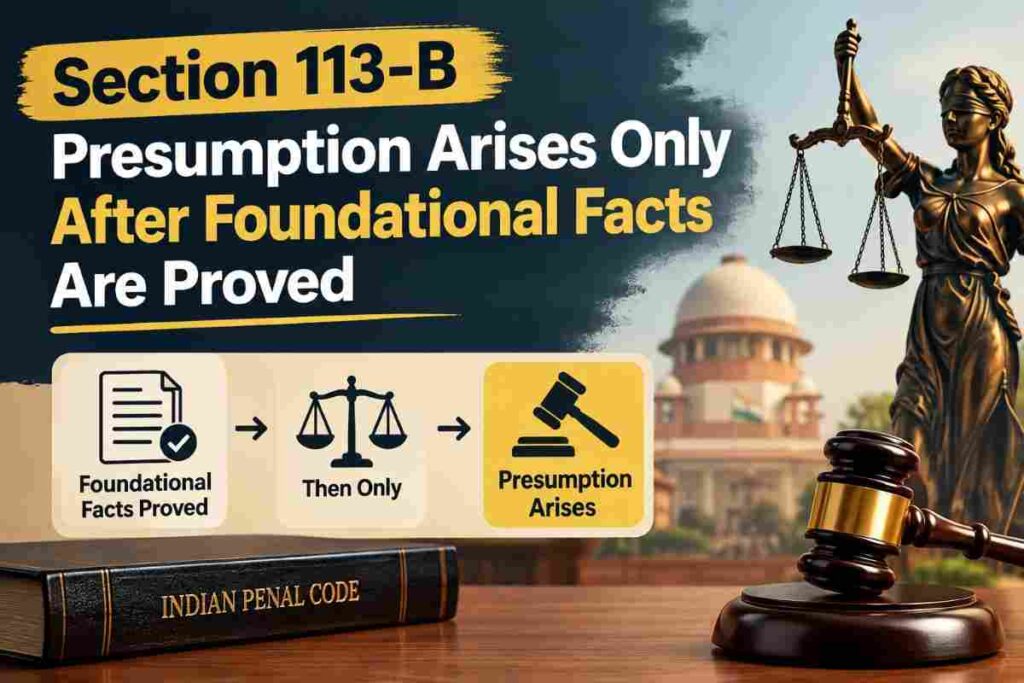
The central question before the High Court was whether the prosecution had established the foundational facts necessary to invoke the statutory presumption of dowry death under Section 113-B of the Indian Evidence Act. The Court emphasised that such a presumption does not arise merely because a married woman dies an unnatural death within seven years of marriage. The prosecution must first establish, beyond reasonable doubt, that the deceased was subjected to cruelty or harassment for, or in connection with, a dowry demand and that such conduct occurred “soon before” her death.
The judgment is significant because it explains the relationship between Section 304-B IPC and Section 113-B of the Evidence Act, particularly the requirement of proving foundational facts before the statutory presumption can operate. The Court also considered the evidentiary value of related witnesses, minor inconsistencies in testimony, and the meaning of the expression “soon before her death.” Ultimately, finding the prosecution evidence sufficiently consistent and the required proximity established, the High Court upheld the conviction and dismissed the appeal.
1. Case Details
| Particular | Details |
|---|---|
| Case Name | Naveen Kumar Verma & Anr. v. State |
| Court | High Court of Delhi at New Delhi |
| Case Number | CRL.A. 677/2004 |
| Date of Decision | 15 September 2026 |
| Bench | Hon’ble Mr. Justice Vimal Kumar Yadav |
| Appellants | Naveen Kumar Verma & Ajay Kumar Verma |
| Respondent | State |
| Relevant Provisions | Sections 304-B, 498-A & 34 IPC; Section 113-B, Indian Evidence Act |
| Final Result | Appeal dismissed; conviction and sentence maintained |
2. Facts of the Case
Vinita @ Kamlesh married Naveen Kumar Verma on 29 November 2002. On 10 April 2003, she was found hanging from a ceiling fan at her matrimonial home. Her marriage had lasted only about four and a half months.
The prosecution alleged that Vinita had been subjected to cruelty and harassment by her husband and brother-in-law in connection with a demand for ₹50,000 as dowry. Statements of her parents and other family members were recorded, following which an FIR was registered under Sections 304-B, 498-A and 34 IPC.
The Trial Court convicted Naveen Kumar Verma and Ajay Kumar Verma under Sections 304-B and 498-A IPC. They were sentenced to 10 years’ rigorous imprisonment under Section 304-B and 3 years’ rigorous imprisonment along with a fine under Section 498-A. The mother-in-law, Kaushalya Devi, was acquitted and her acquittal was not challenged by the State.
3. Issues Before the High Court
The principal questions before the Court were:
- Whether the prosecution had proved that Vinita was subjected to cruelty or harassment in connection with a dowry demand soon before her death.
- Whether the requirements of Section 304-B IPC were satisfied.
- Whether the statutory presumption under Section 113-B of the Evidence Act could be invoked.
- Whether the Trial Court’s conviction suffered from any perversity warranting appellate interference.
4. Arguments of the Appellants
The appellants argued that the prosecution case was based primarily on relatives of the deceased and lacked independent corroboration. They highlighted alleged inconsistencies concerning the dowry demand and an alleged telephone call shortly before the death.
They further contended that there were no specific allegations establishing their individual roles, no physical injuries were found on the deceased, and the prosecution witnesses had made improvements in their statements. They argued that the conviction was based on general allegations rather than legally sufficient evidence.
5. Arguments of the State
The State submitted that the evidence of PW-1 to PW-5 consistently established the demand for ₹50,000 and the harassment of the deceased. It argued that family members were natural witnesses because the alleged cruelty occurred within the matrimonial home.
The State also relied upon the short period between the marriage and death and submitted that the circumstances attracted the presumption under Section 113-B of the Evidence Act.
6. Court’s Analysis
The High Court held that the prosecution evidence consistently established a specific demand of ₹50,000. Although there were variations concerning certain details, particularly the alleged telephone call, the core allegation of dowry demand and harassment remained consistent.
The Court also rejected the argument that the witnesses should be disbelieved merely because they were related to the deceased. A related witness is not automatically an interested witness. Where an offence occurs inside the matrimonial home, family members may naturally be the persons to whom the victim communicates her difficulties.
Foundational Facts Must Be Proved First
One of the important aspects of the judgment concerns the operation of Section 113-B of the Evidence Act.
The Court clarified that the presumption relating to dowry death does not arise automatically merely because a married woman dies unnaturally within seven years of marriage.
The prosecution must first establish, beyond reasonable doubt, the foundational facts constituting an offence under Section 304-B IPC. These include proof that the deceased was subjected to cruelty or harassment by the accused for or in connection with a dowry demand and that such treatment occurred soon before her death.
Only after these foundational facts are established does the statutory presumption under Section 113-B arise against the accused.
Meaning of “Soon Before Death”
The Court reiterated that “soon before her death” does not mean “immediately before her death.” It is a relative expression requiring a proximate and live connection between the dowry-related cruelty or harassment and the death.
There is no fixed period applicable to every case. The Court must examine the facts and circumstances of each case to determine whether the required proximity exists.
In the present case, the marriage itself had lasted only approximately four and a half months, and the allegations indicated that the harassment and dowry demand continued during that period. The Court therefore found the proximity requirement satisfied.
7. Important Legal Provisions
Section 304-B IPC — Dowry Death
Section 304-B applies where a married woman dies otherwise than under normal circumstances within seven years of marriage and it is shown that soon before her death she was subjected to cruelty or harassment by her husband or his relative in connection with a dowry demand.
The Court emphasised that the prosecution must establish the foundational ingredients before the statutory presumption can operate.
Section 498-A IPC — Cruelty
Section 498-A concerns cruelty by a husband or his relative towards a married woman. The Court noted that cruelty under Section 498-A is not necessarily confined to conduct connected with dowry.
Section 113-B Evidence Act — Presumption as to Dowry Death
Section 113-B becomes relevant after the prosecution establishes the foundational facts of a dowry death. Once those facts are established, the statutory presumption operates against the accused, subject to rebuttal.
8. Important Precedents
| Precedent | Principle | Use in the Judgment |
|---|---|---|
| Gurdip Singh v. State of Punjab | Ingredients required to establish dowry death | Used to identify the requirements of Section 304-B |
| Rajesh Yadav v. State of U.P. | A related witness is not automatically an interested witness | Used while assessing evidence of family members |
| Goverdhan v. State of Chhattisgarh | Minor discrepancies do not necessarily destroy otherwise credible testimony | Applied in evaluating variations in witness testimony |
| State of Madhya Pradesh v. Jogendra | “Soon before” requires a proximity test and live link | Applied to the timing of dowry-related harassment |
| Kans Raj v. State of Punjab | “Soon before” is a relative expression requiring factual assessment | Relied upon in explaining the proximity requirement |
| Manohar Lal v. State of Haryana | Dowry-related harassment must be established soon before death | Distinguished on its facts |
| Shobhit Kumar Mittal v. State of Uttar Pradesh | Considered in the context of allegations lacking specific acts | Distinguished from the present factual situation |
9. Ratio Decidendi
The core legal principle emerging from the judgment is:
In a prosecution for dowry death under Section 304-B IPC, the prosecution must first establish beyond reasonable doubt the foundational facts, including dowry-related cruelty or harassment soon before the woman’s death. Only after those facts are established does the statutory presumption under Section 113-B of the Evidence Act arise against the accused.
10. Final Decision
The Delhi High Court found no reason to interfere with the Trial Court’s findings. It held that the evidence sufficiently established the dowry demand and harassment and that the circumstances satisfied the proximity requirement under Section 304-B IPC.
The conviction dated 16 August 2004 and sentence dated 17 August 2004 under Sections 304-B and 498-A IPC were maintained.
The appeal was dismissed, and the appellants were directed to surrender to undergo the remaining sentence, with the benefit of set-off under Section 428 Cr.P.C.
11. Key Takeaways
- Section 113-B does not create an automatic presumption merely because a married woman dies unnaturally within seven years of marriage.
- The prosecution must first prove the foundational ingredients of Section 304-B IPC.
- Dowry-related cruelty or harassment must have a proximate connection with the death.
- “Soon before death” is a relative expression and has no rigid statutory time limit.
- Related witnesses cannot be rejected merely because they are family members.
- Minor discrepancies in witness testimony do not necessarily destroy an otherwise consistent prosecution case.
- Once the foundational facts are proved, the Section 113-B presumption operates against the accused.
- The presumption remains rebuttable by the accused through evidence.
- Absence of physical injuries does not, by itself, rule out cruelty or dowry-related harassment.
- The judgment reinforces the distinction between proving the foundational facts and applying the statutory presumption.
14. Conclusion
The Delhi High Court’s decision in Naveen Kumar Verma & Anr. v. State reinforces an important evidentiary sequence in dowry death prosecutions. The statutory presumption under Section 113-B of the Evidence Act is significant, but it is not a substitute for the prosecution proving the foundational facts required by Section 304-B IPC.
In the present case, the Court found that the evidence concerning the ₹50,000 dowry demand and the continuing harassment was sufficiently consistent and proximate to the death. Consequently, the presumption under Section 113-B was attracted and the appellants failed to rebut it. The conviction under Sections 304-B and 498-A IPC was therefore maintained.